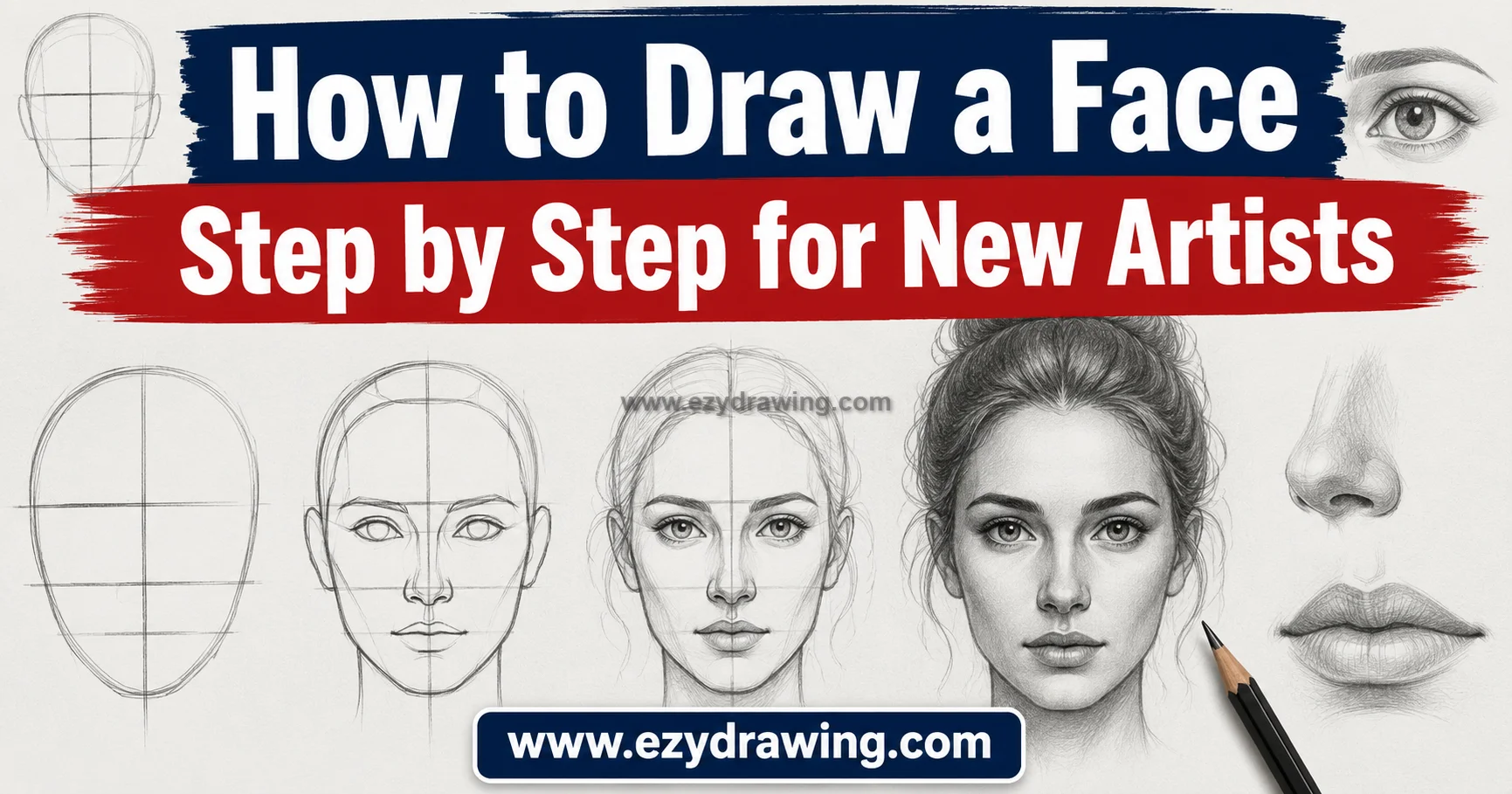
How to Draw a Face Step by Step for New Artists
Welcome to this beginner’s guide on how to draw a face. Learning portraiture can seem intimidating, but the process becomes straightforward when broken down into manageable structural steps.
By following these 6 sequential stages, you will build a properly proportioned human face from scratch. Instead of rushing into details, this guide first helps you understand how to draw with simple shapes, light guide lines, accurate spacing, and balanced facial proportions before adding shading, expression, and final refinement.
This visual tutorial is designed to provide clear, front-angle references for each phase of construction.
Step-by-Step Face Drawing Practice for Beginners
How to Draw a Face Easily with Simple Beginner Steps is a helpful guide for new artists who want to learn face drawing without feeling confused. By starting with basic shapes, light guide lines, simple facial proportions, and soft shading, beginners can slowly build a clean portrait sketch with more confidence.
Step 1: Establish the Primary Structures (The “Egg”)
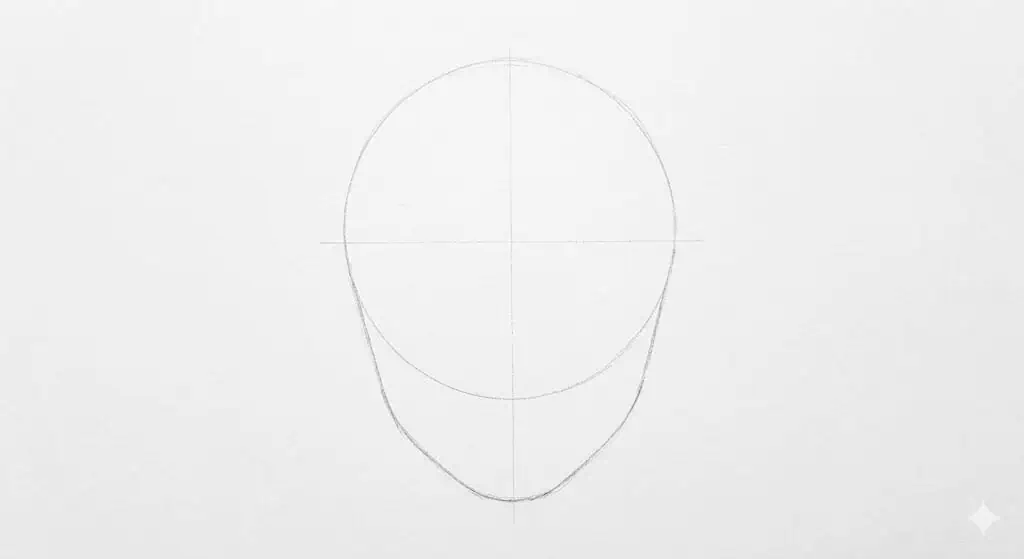
The foundation of any face is built using basic geometry. We begin with a perfect circle to represent the cranium (the main mass of the head).
Next, we establish the jawline by extending a curved “U” shape down from the sides of the circle. This creates a large, slightly elongated egg shape. Crucially, we must draw two primary guidelines: a vertical centerline (ensuring perfect symmetry) and a horizontal axis crossing the absolute midpoint of the entire shape. The initial circle, jaw outline, and these axis lines are kept very light and purely structural.
Step 2: Mapping the Features (The Grid)
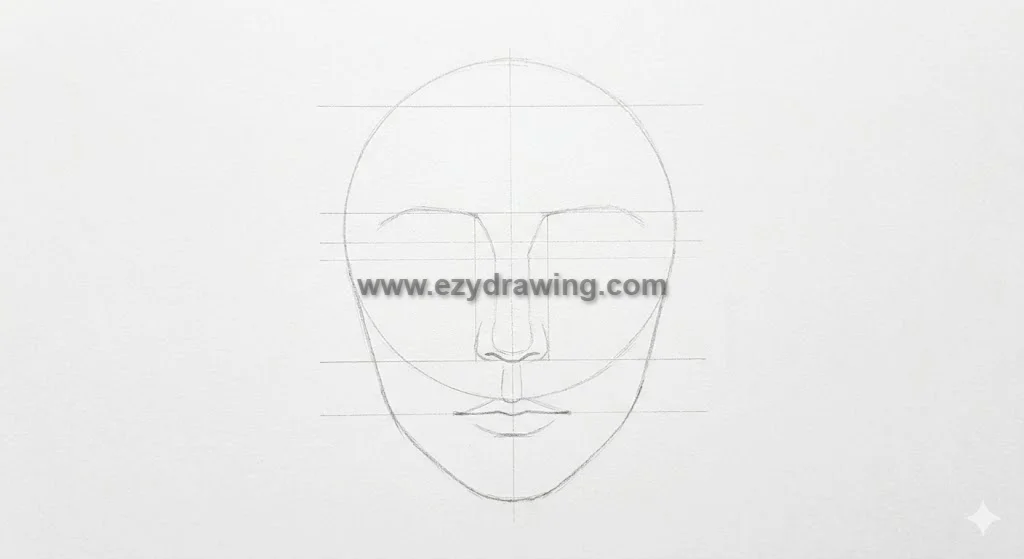
Once the overall egg shape (Image 1) is secure, we must map where the features belong. Proportion is everything. We now divide the face into classic artistic sections using additional horizontal guidelines:
- Eyes: The central horizontal axis established in Step 1 is exactly where the center of the eyes will sit.
- Nose: Divide the space between the eye line and the chin in half; this new line marks the bottom of the nose.
- Mouth: Divide the space between the nose and the chin into thirds; the top third line marks the opening of the mouth.
- Hairline: A top guideline is added for the hairline (about one unit up from the eyes).
We also place two faint vertical lines to mark the width of the nose and the inner corners of the eyes. Your paper now has a precise grid tailored for placing the features.
Step 3: Placing the Eye Shapes
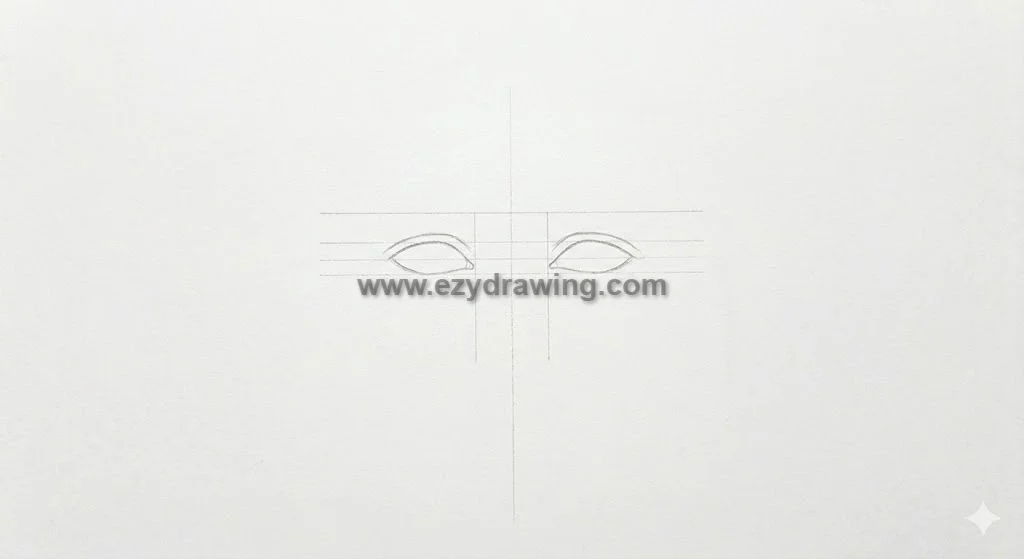
With the placement grid firmly established (Image 2), we now introduce the most complex feature: the eyes. Using the central horizontal axis and the vertical dividers as guides, we draw two almond-shaped outlines.
The core rules applied here are based on simple facial proportion: the space between both eyes should be about one full eye-width, and the eyes should sit evenly along the horizontal midline of the face.
Use the vertical centerline as your symmetry guide, making sure both eye shapes mirror each other in size, angle, and placement. At this stage, focus only on creating the basic empty eye shapes, not the irises, pupils, lashes, or shading.
Keep your pencil pressure very light so the lines stay easy to adjust later. This step is mainly about accuracy and balance, helping the face look natural before adding detailed features.
Step 4: Adding the Core Features (Nose and Mouth)
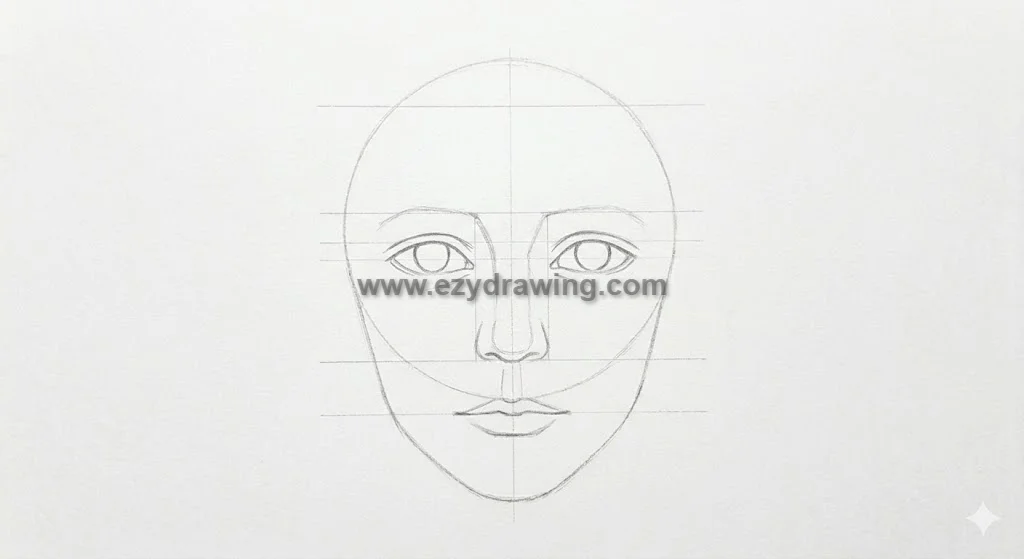
The structure is now ready for the remaining features. Following the vertical guides extended from the inner corners of the eyes, we define the width of the nose. On the ‘nose line’ established in Step 2, we sketch the base of the nose and the subtle curves of the nostrils.
Next, we move to the mouth line, which helps place the lips in the correct position on the face. A useful guideline is that the corners of the mouth usually align vertically with the center of the pupils, so faintly mark those points before drawing the lips.
Start with light, simple strokes to form the soft “M” shape of the upper lip, then add the gentle “U” curve of the lower lip underneath. Avoid making the lips too dark or detailed at this stage, because the goal is only to build the structure.
With the eyes, nose, and mouth now placed correctly, the basic face sketch is complete and ready for shading, volume, and final refinement.
Step 5: Introducing Shading and Depth
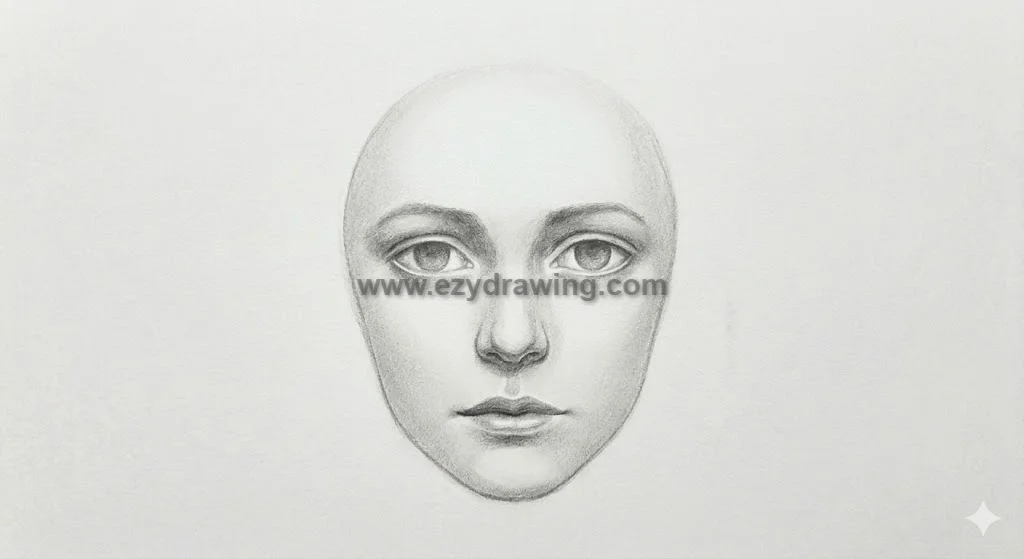
We now transition from a line drawing (Image 4) to a three-dimensional form. This requires shading. Using the side of a soft pencil, we lightly introduce gradient tones to define plane changes and volume.
Focus the softest shading where light is naturally blocked:
- The Eye Sockets: Shading the upper eyelid and the socket deepens the eyes.
- Under the Nose: Define the shadow cast by the nose.
- The Lower Lip: A soft shadow beneath the lower lip creates fullness.
- The Jawline: Subtle tone along the neck and jaw separates the head from the body. We keep the shading light and observational, avoiding heavy contrast at this stage.
Step 6: Final Details and Refinement
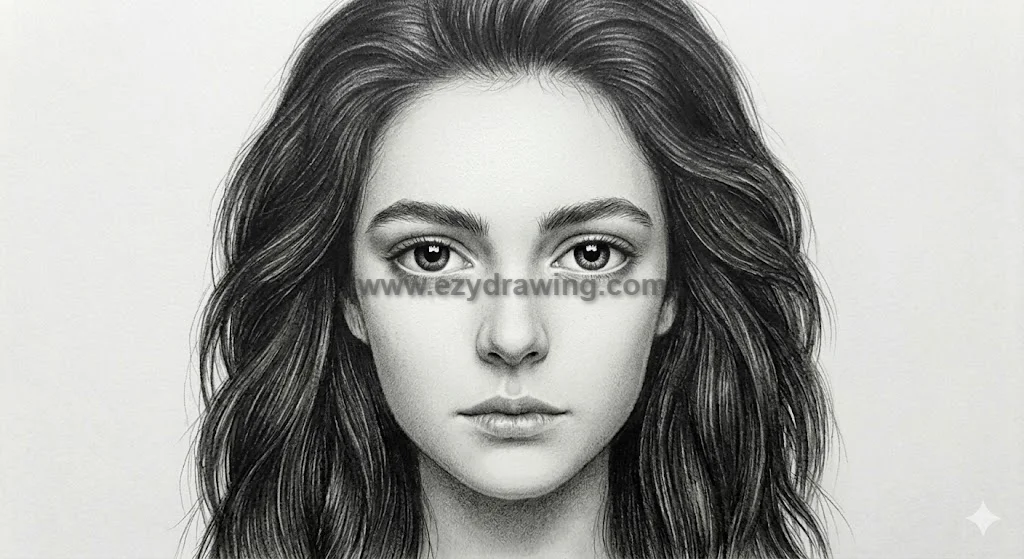
The final step is about polish and definition, moving from a tonal study (Image 5) to a finished portrait. We dramatically increase the contrast:
- Use a dark, 4B pencil to render the pupils to deep black, leaving a crisp white highlight for the “catchlight.”
- Define individual hairs in the eyebrows.
- Add hair and ears to complete the context. The hair is rendered in dark, flowing masses that follow the cranium’s volume.
- We erase all remaining grid lines.
- Finally, we add subtle textures (skin pores, soft highlights) to make the image photorealistic. The lighting is now focused, giving the drawing high contrast and a polished texture.
Conclusion
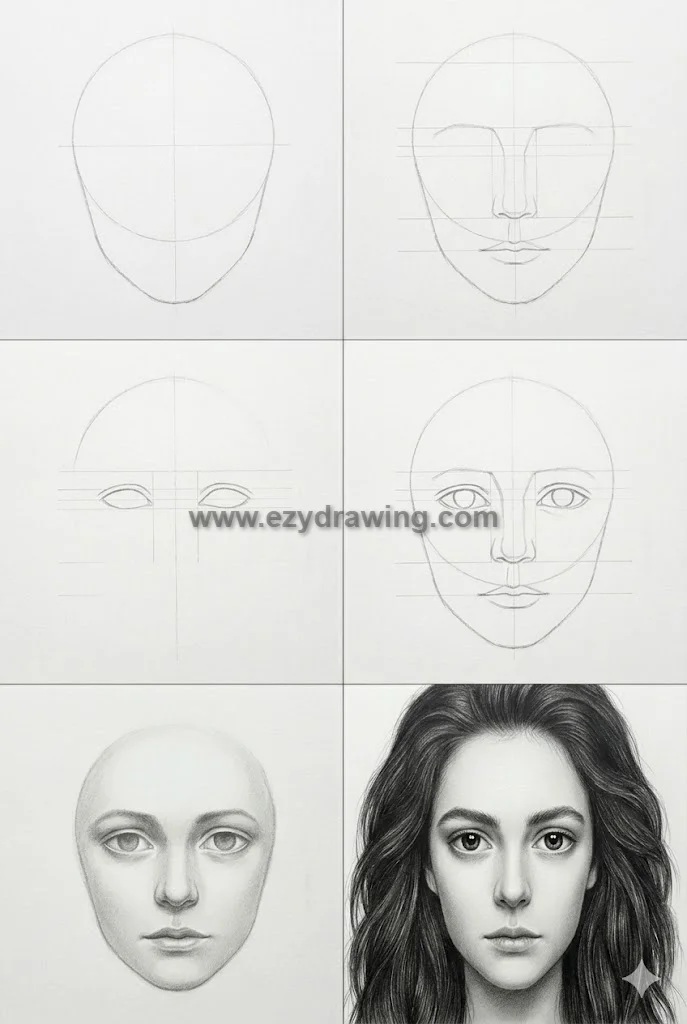
You have now completed the 6 essential steps. By mastering this structural approach, how to draw a face becomes a repeatable process of constructing geometry, mapping proportions, and finally applying texture. Remember that the early, light guidelines (like those in Images 1 and 2) are the most critical; if the underlying structure is correct, your final details (Image 6) will always succeed. Practice these stages sequentially.