How to Draw Nose Simply With Stunning Sketch Tips
Mastering portraiture requires understanding the subtle, organic forms of the face. Many artists find the center of the face challenging, but learning how to draw a nose is straightforward once you structure the anatomy.
By breaking the nose down into basic geometric blocks and gradually refining the lighting, you can create depth and realism. This how to draw method keeps the process simple and beginner-friendly. This tutorial walks you through six specific stages, guiding you from simple constructions to a polished, rendered drawing.
Simple Techniques for Sketching a Realistic Nose
How to Draw Nose Perfectly With Easy Art Lessons is a simple beginner-friendly guide that helps you understand nose structure, nostril placement, soft shading, and realistic pencil details.
By starting with basic shapes and slowly building shadows, highlights, and smooth curves, you can create a clean nose sketch that looks balanced, natural, and easy to improve with practice. This drawing nose process also helps beginners understand structure, shading, and proportion more clearly.
Step 1: Laying the Foundation Basic Geometry
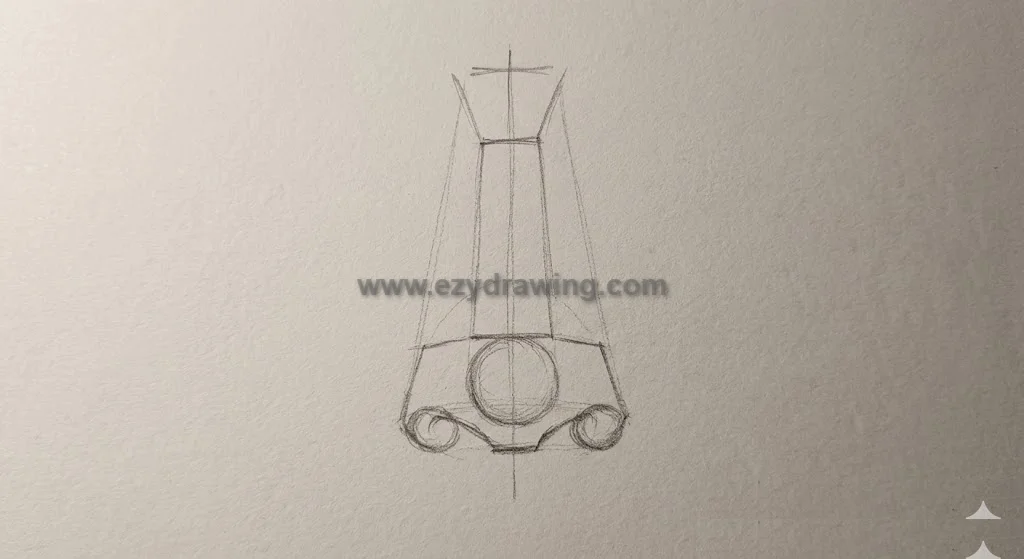
The first step in learning how to draw a nose is establishing the basic structure using simple geometry. Do not focus on soft contours yet. We begin with a strong vertical centerline (the axis of symmetry). Over this, we construct a trapezoid for the main bridge and a centered sphere for the bulbous tip. This simple arrangement defines the scale and placement of the nose on the face.
Visual Description: Image 1 shows only essential construction lines on textured paper. A vertical centerline dictates symmetry. A geometric trapezoid defines the bridge, and a simple sphere defines the nose tip.
Step 2: Defining the Nostril Wings The Alae
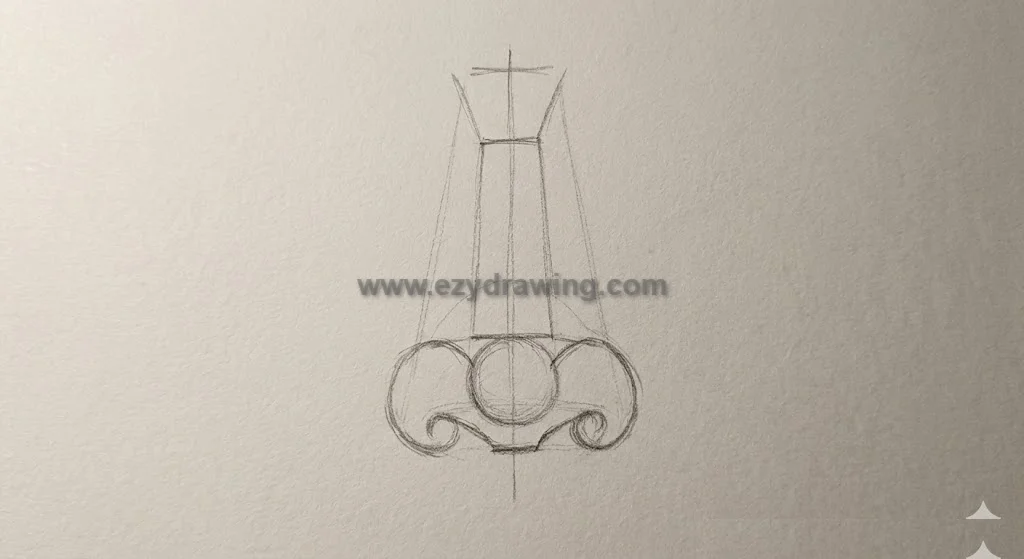
Building directly upon the structure established in Image 1, we now define the outer limits of the nose. We expand the base by sketching two curves anchored to the central sphere. These define the “alae” (the wings of the nostrils). Notice that these curves look like slightly flattened “C” shapes that frame the central bulb, adhering strictly to the structural width established by the underlying geometry.
Visual Description: Image 2 shows the original geometric sketch, but now simple, curved ‘C’ lines are added symmetrically, defining the outer nostril wings (alae).
Step 3: Mapping the Nostril Cavities
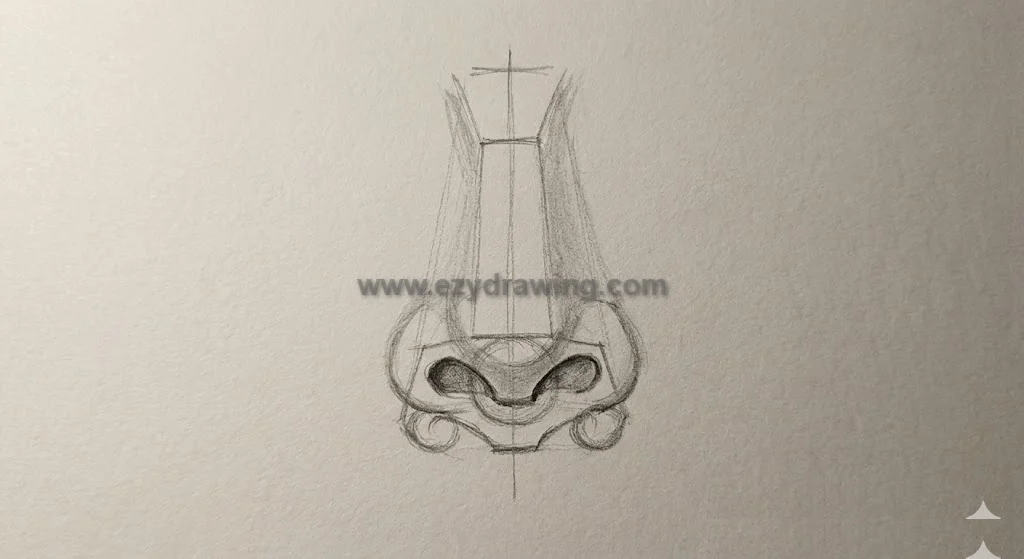
We now transition from simple lines to defining volume. Referring to the anchors we created in Step 2, we must indicate where the nasal passage begins. We are not shading yet; we are “mapping” the darkest accents. These two dark, defined, teardrop-shaped marks (the actual nostril openings) are drawn symmetrically beneath the central sphere, resting just inside the curves of the alae defined previously.
Visual Description: Image 3 shows the structure from previous steps. The main change is the addition of two distinct, dark, teardrop-shaped accents drawn symmetrically beneath the central sphere. These map the nostril openings.
Step 4: Introducing Initial Shading Defining Light
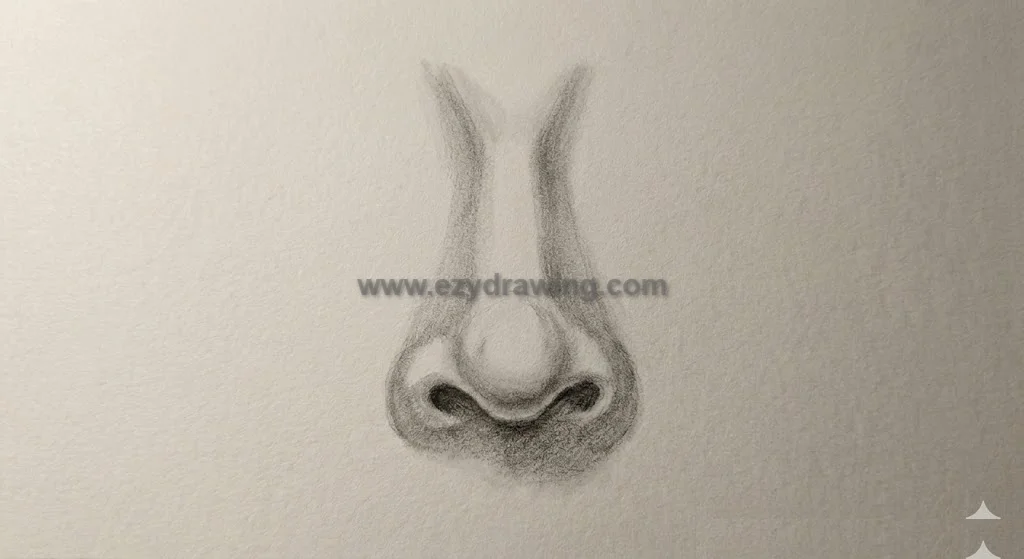
This is a critical turning point where the drawing transitions from a 2D diagram to a 3D form. We must now apply soft, initial graphite shading (using a soft pencil or blending tool). Crucially, this shading must follow the underlying structure defined in Steps 1 and 2. We lightly shade the sides of the trapezoid bridge and the under-surface of the nasal tip sphere. This defines where the light source is (in this case, coming from the front-left, leaving the right side in shadow). The geometric lines are still visible but are now softened by the tone.
Visual Description: Image 4 shows soft, initial graphite shading applied to the sides of the geometric structure (defined in Image 1). This shading defines the volume of the bridge and the underside of the tip sphere, transitioning the sketch from a linear diagram to a volumetric form.
Step 5: Developing Subtlety and Texture
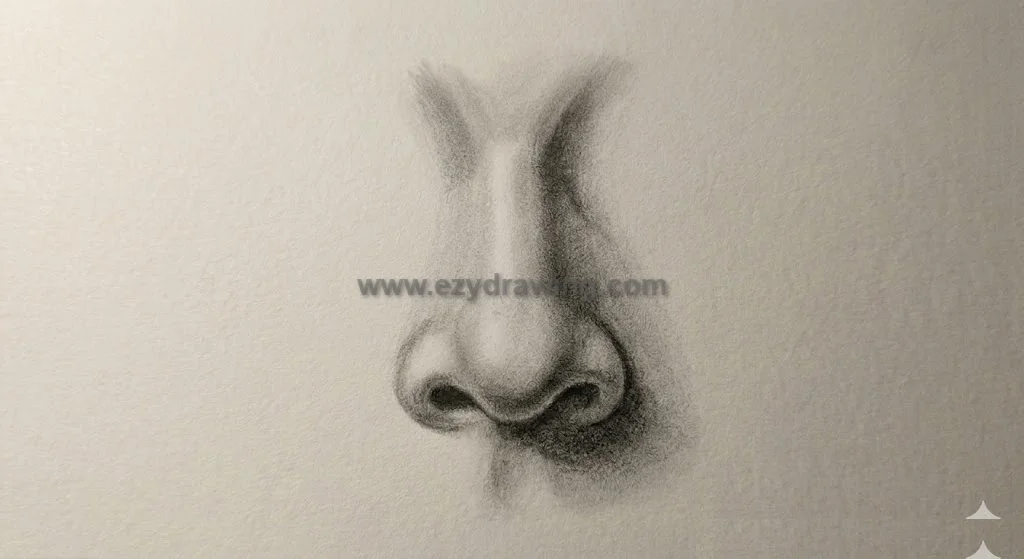
We have the structure and initial shadows; now we introduce realistic texture. We intensify the shading, making the deep shadows (the nostril cavities from Step 3) much darker. We blend the shadows on the bridge (Step 4) so they transition smoothly.
A new, subtle application of graphite now defines the light side of the nose, modeling the cartilage of the bridge and tip with very soft, diffused gradients. This how to draw nose stage makes the sketch look smoother, softer, and more realistic. The lines of the geometric scaffold are now completely lost within the blended rendering.
Visual Description: Image 5 shows a highly blended graphite drawing. The original geometric scaffold (from Image 1) is completely gone. Deep shadows define the openings, and very soft gradients on the cartilage define realistic volume. The texture of the paper is now visible through the soft, layered graphite.
Step 6: Finalizing High Contrast and Detail
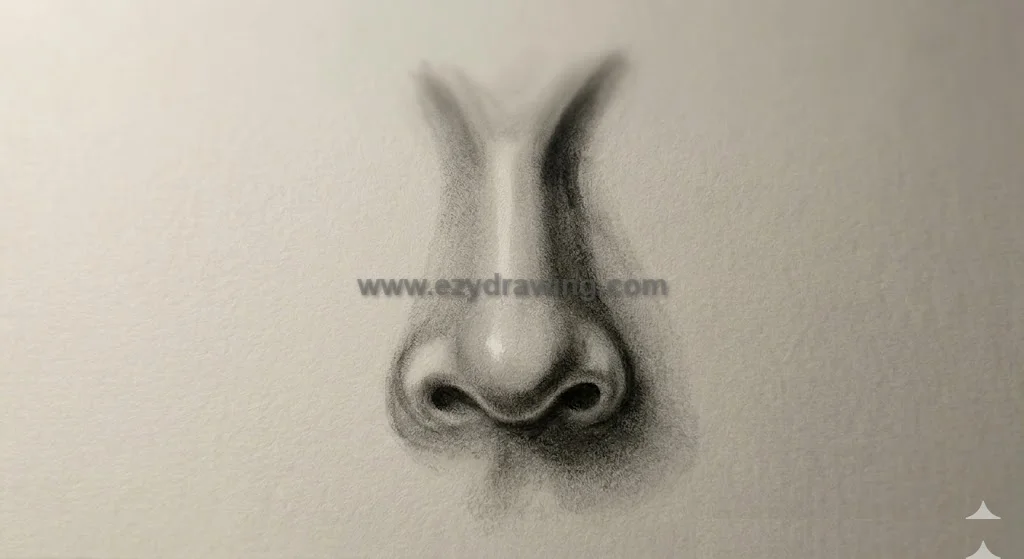
The final step is about maximizing contrast. We refine the previous stage (Image 5) by introducing the deepest blacks and the brightest highlights. We make the nostril openings pitch black (deep accents).
Shadows are deepened on the right side and beneath the tip to push the nose forward in space. Finally, we use a precision eraser to pick out strong, crisp specular highlights on the very tip of the nose and along the bridge. This how to draw nose step helps create a more realistic and polished final result. This finalized contrast is what creates the illusion of moisture and a realistic 3D form.
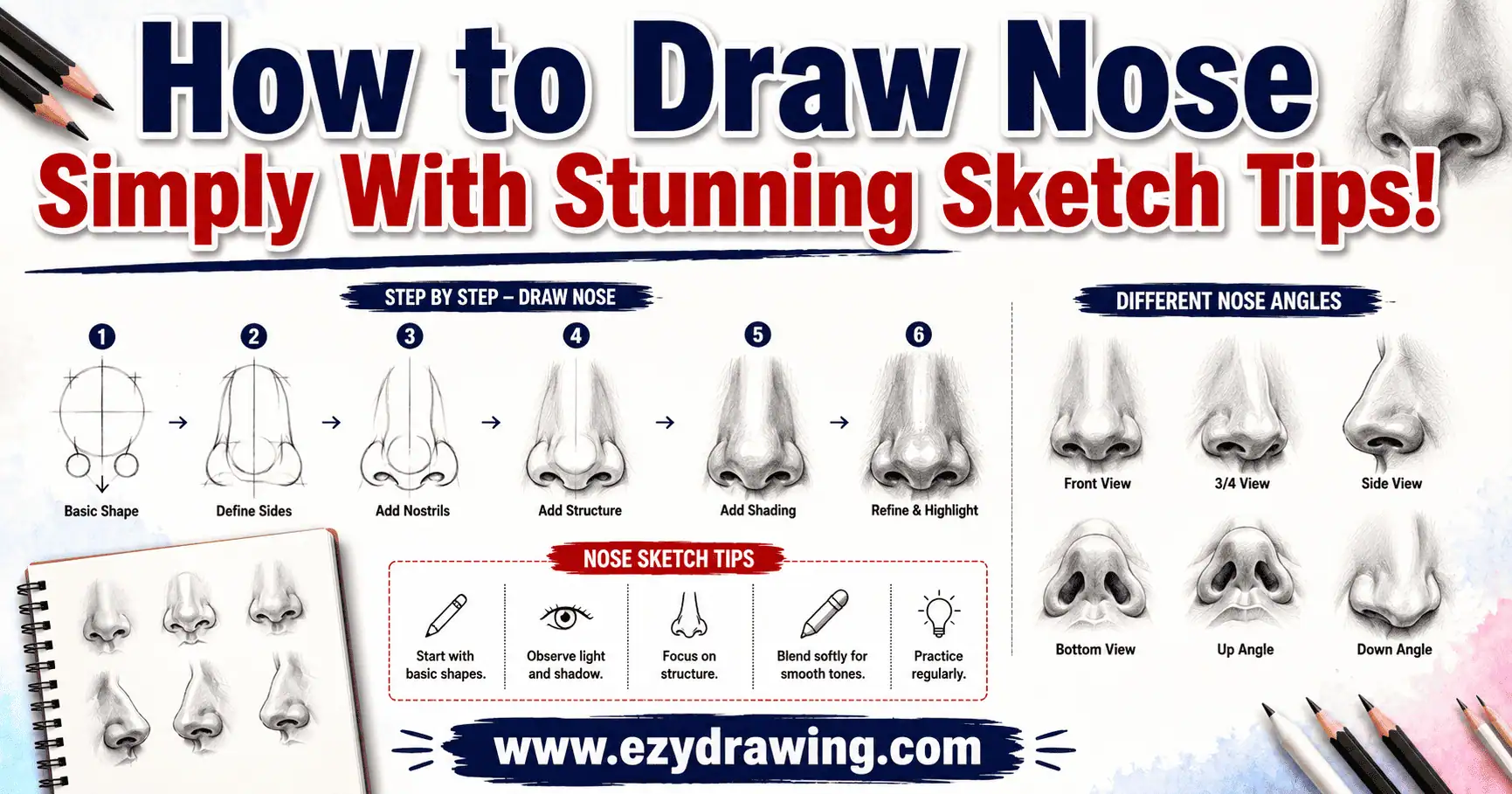
Step-by-Step Overview All 6 Steps
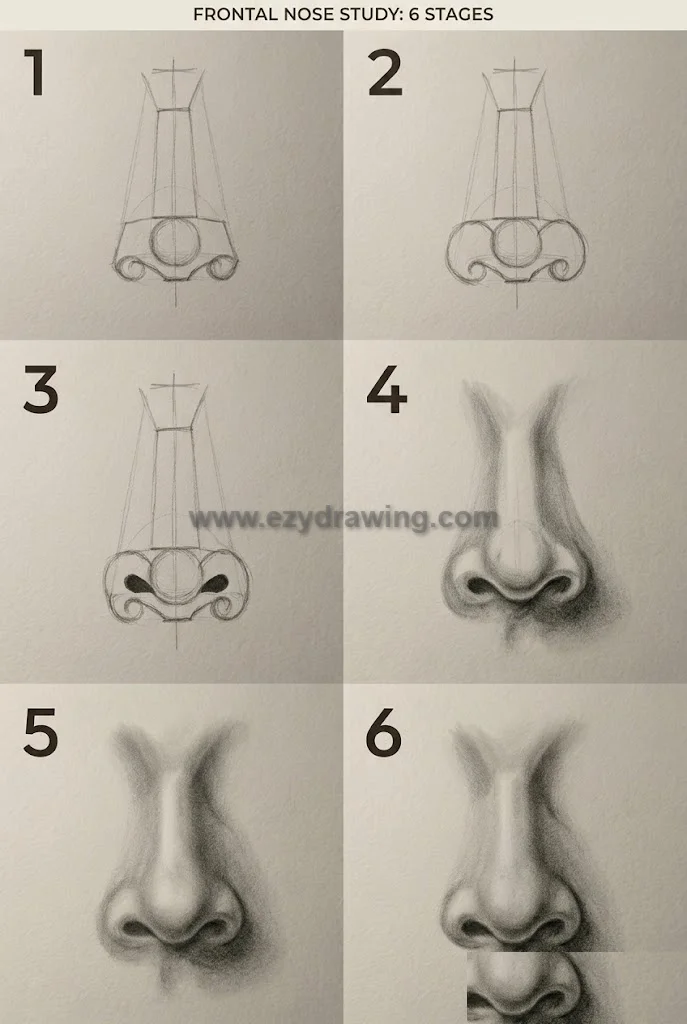
Below is the complete, single compilation image displayed in a 2:3 aspect ratio, tracking the entire transformation from the initial construction lines to the fully rendered, realistic final sketch.
Visual Description: A single composite image in a 2:3 vertical ratio displaying all 6 drawing steps arranged in a clean, numbered grid layout.
It shows the progressive transformation of the front-facing nose from the initial structural geometric sketch to the final, highly rendered graphite drawing with deep shadows and specular highlights. This how to draw nose guide clearly shows each stage in a simple visual sequence.
Conclusion
Mastering how to draw nose shapes accurately comes down to looking past the soft skin and understanding the solid, geometric forms underneath. By breaking the feature into a simple trapezoid, circles, and curves, you eliminate the guesswork and build a balanced foundation.
From there, smooth blending and sharp value contrast do the heavy lifting to create a realistic, three-dimensional look. Keep practicing this structured framework, and you will notice a massive improvement in your portrait drawing skills.