How To Draw Lips Cute Creative Drawing Guide
Welcome to this drawing tutorial! Learning how to draw lips is a fundamental skill for portrait artists. While they might seem like simple soft shapes, mastering their construction involves understanding underlying structure and subtle shading.
This guide breaks down the process into six clear, manageable steps, helping you understand how to draw with better control and confidence, starting with a simple armature and building up to a polished, volumetric form.
Simple Techniques for Sketching Cute Lips
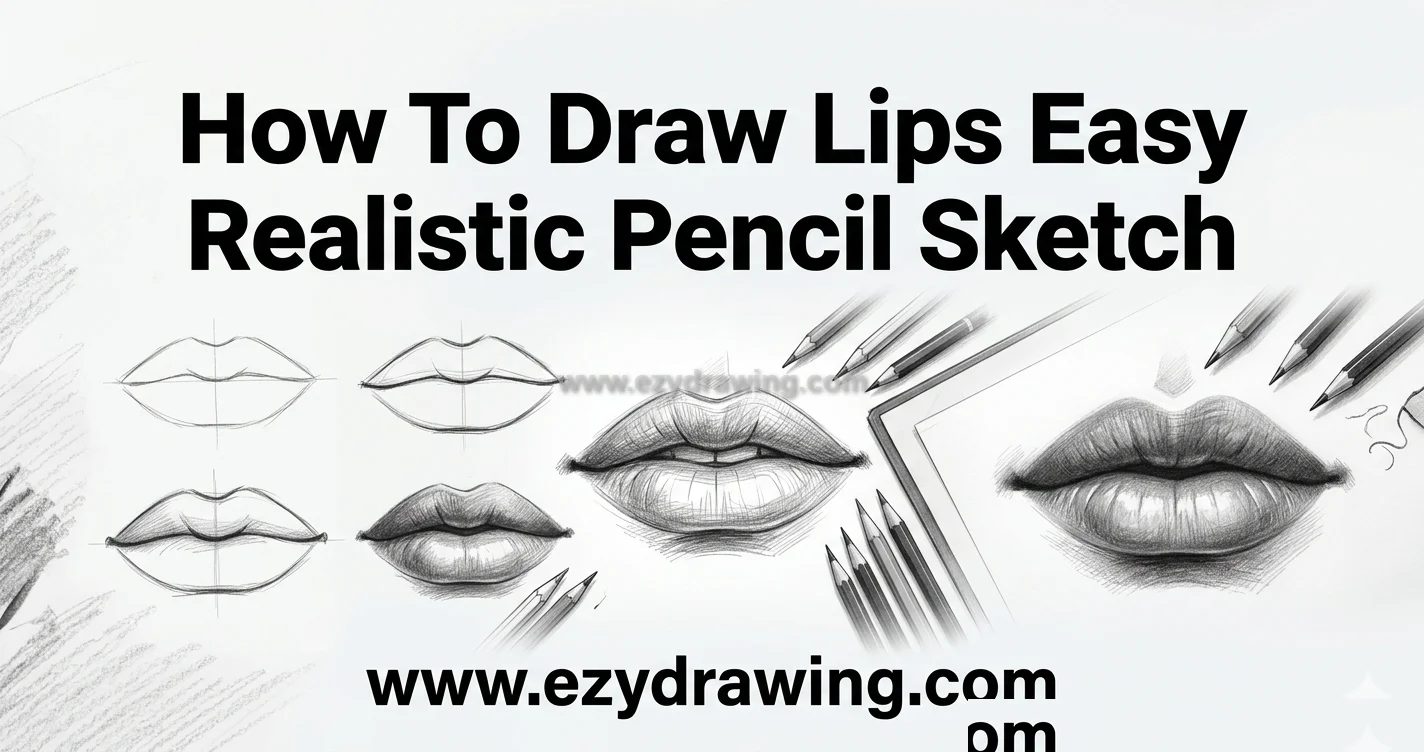
How To Draw Lips Easy Realistic Pencil Sketch is a helpful beginner-friendly way to practice soft mouth shapes, lip curves, and natural shading. Start with a light center line, build the upper and lower lip with simple forms, then add gentle shadows to create depth and realism.
With careful pencil strokes, your lip drawing can look smooth, balanced, and more expressive, making easy lips draw practice feel simple and enjoyable for beginners.
Step 1: The Initial Armature The Bow

The secret to symmetrical and well-proportioned lips is a simple grid. Do not draw outlines yet. We start by establishing the primary vertical centerline (matching the philtrum above) and a horizontal guideline for where the lips meet.
The most crucial structural marker is a small, soft ‘V’ shape right in the center of the horizontal line. This defines the cupid’s bow. Below it, a wide, shallow ‘U’ shape marks the center point of the lower lip. This is the foundation for how to draw lips with better shape and balance. Keep these lines very light.
Step 2: Defining the Three Main Masses
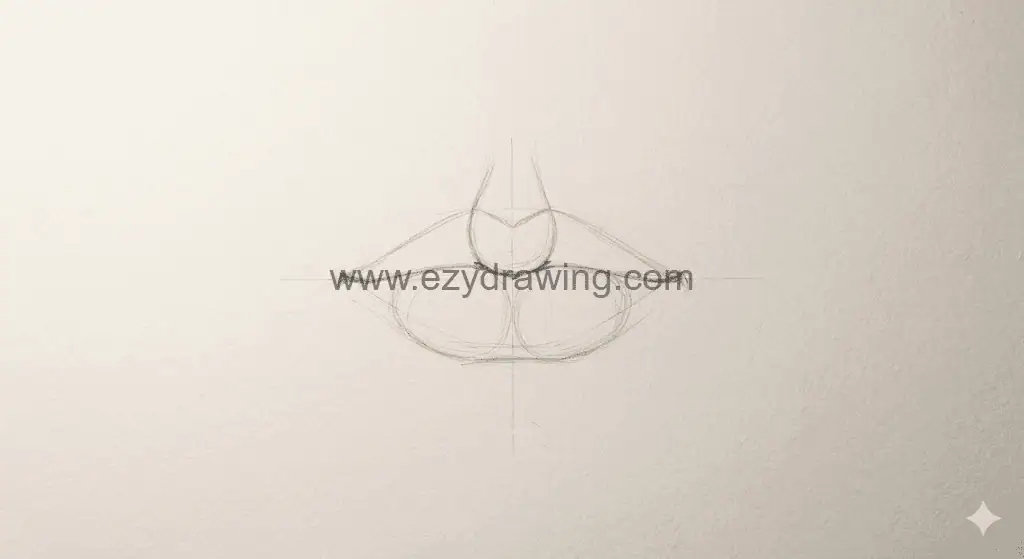
Using the established center markers from Step 1 (the ‘V’ and ‘U’), we now define the volume. Think of the lips not as flat shapes, but as three fleshy pads:
- One central, teardrop-shaped mass forms the body of the upper lip (building upon the ‘V’).
- Two large, oval masses form the left and right sides of the lower lip (building upon the ‘U’).
The outer corners of the mouth are marked slightly higher than the center line. We begin sketching the actual boundary where the lips meet, defining that subtle, characteristic “M” shape of the upper lip structure.
Step 3: Establishing the Main Planes and Shadows
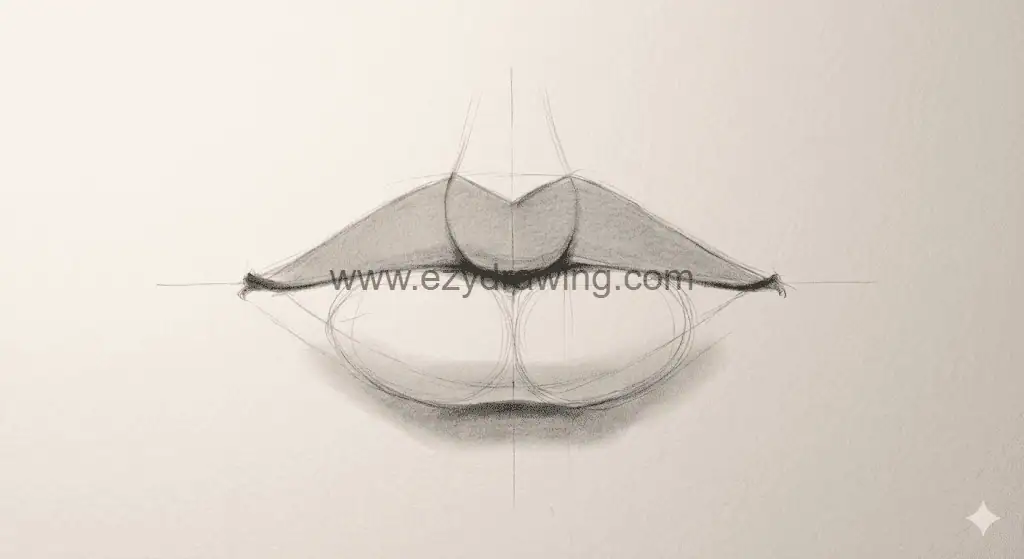
Now we transition from simple shapes to form by applying basic light logic. We are defining the planes. The upper lip angles down and usually receives less light, making it darker overall. The lower lip curves out and catches light on its top surface, but casts a shadow beneath itself.
In this step (referencing the structures from Step 2), we softly shade the entire upper lip. The line where the lips meet (the opening) is now significantly darkened to establish depth. A soft shadow is placed beneath the lower lip to ground it. The volumetric “pads” from Step 2 are still visible but beginning to merge.
Step 4: Adding Volumetric Tone and Contours
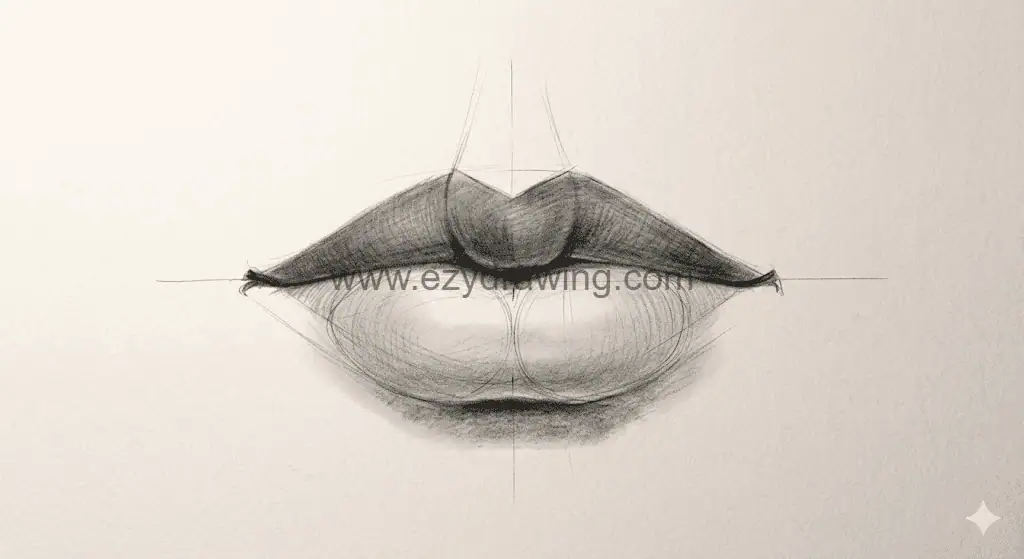
We now move from basic shading to creating fleshy volume. We analyze the specific contour of the lips defined in Step 2.
Using a softer pencil, we apply tone structurally. Instead of flat shading, we use cross-contour lines—faint, curved lines that follow the form of the rolling pads of flesh (the ovals and teardrop). We darken the core shadows—specifically on the upper lip and the deep corners of the mouth—making them recede. The center of the lower lip is left lighter, emphasizing its outward curve. The soft edge of the vermilion border (the outer edge of the lips) is gently defined, shifting from the sharp armature of Step 1 to a soft, natural transition.
Step 5: Introducing Texture and Fine Details
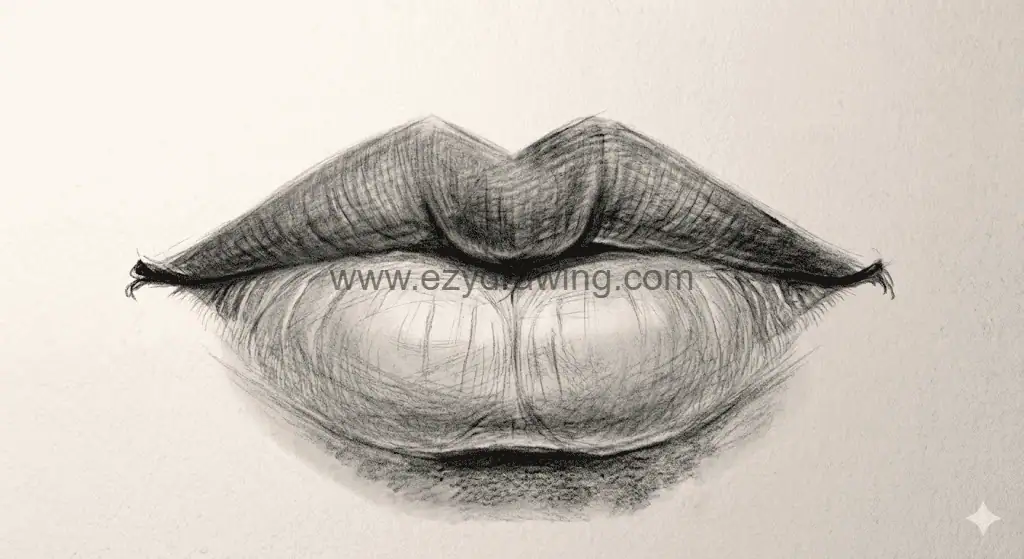
This is where the realism develops. Until now, the shading has been smooth. Now we add the characteristic texture: fine vertical cracks and wrinkles.
Using a very sharp, dark pencil, begin drawing subtle, irregular vertical lines that radiate from the center opening toward the outer edges of both lips. Note how these lines must wrap around the volumetric forms established in Step 4. They should not be perfectly straight. We also subtly darken the very center shadow just beneath the cupid’s bow and the extreme corners of the mouth, deepening the three-dimensional effect. The light areas on the lower lip remain, but are now broken up by this new texture.
Step 6: Final Polish, Highlights, and Integration
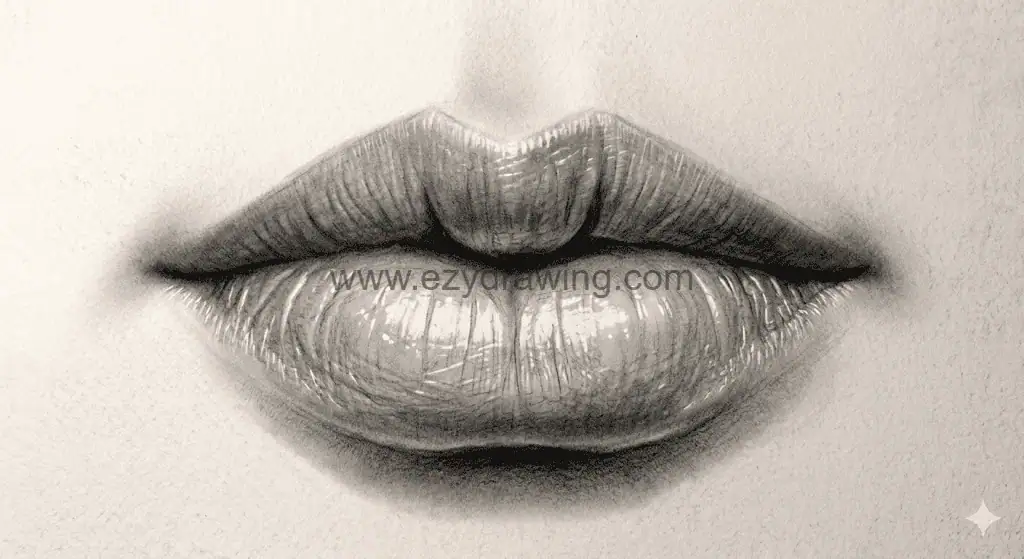
The final step is about blending and contrast. We review the entire drawing (which now has the structure of Step 2, the volume of Step 4, and the texture of Step 5).
Use a blending tool (like a tortillon or dry brush) to softly knock back some of the sharpest texture lines from Step 5, integrating them into the underlying volume. We now intensify the darkest shadows—the very center of the mouth opening and the shadow beneath the lower lip—making them deep, rich black.
Finally, we introduce specular highlights. Use a precise eraser (like a mono zero eraser) to punch out bright white highlights on the highest points of the lower lip’s rounded masses. This contrast between deep shadow and bright highlight creates the illusion of moisture and shine, completing the realistic look.
The image below summarizes the entire process, showing all six stages of the drawing’s evolution side-by-side, from the initial, extremely faint armature to the polished, photorealistic finish.
The Complete 6-Step Visual Guide
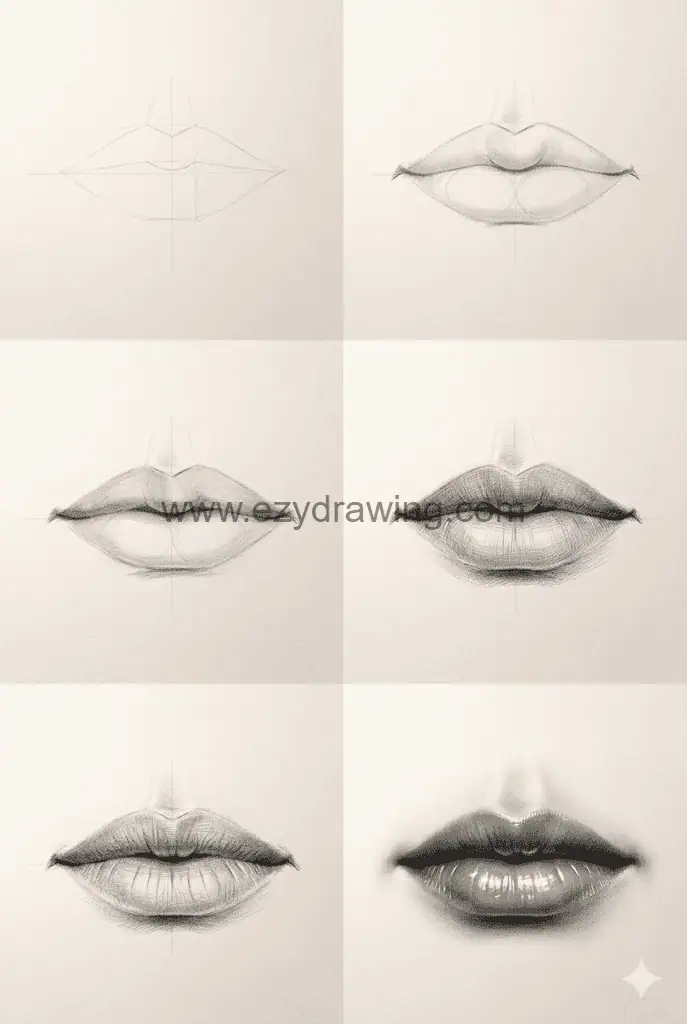
The image below summarizes the entire process, showing all six stages of the drawing’s evolution side-by-side, from the initial, extremely faint armature to the polished, photorealistic finish.
Conclusion
By following these steps, you have progressed from a few faint structural guidelines to a fully realized, volumetric drawing. Remember that mastering how to draw lips is about seeing the complex form (the five fleshy pads) and understanding how light interacts with those rolling surfaces. The texture and highlights are just the final polish on top of a solid structure. Keep practicing this structured approach, and your lip drawings will show consistent improvement.