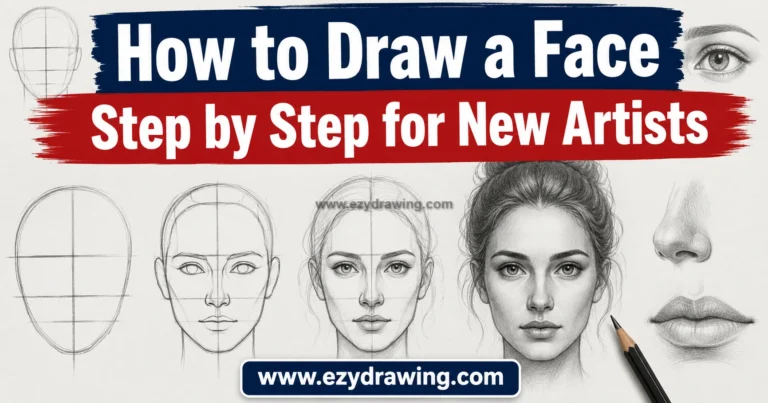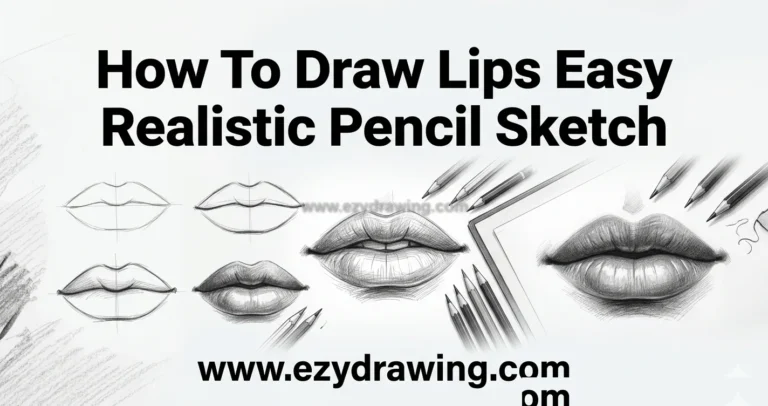
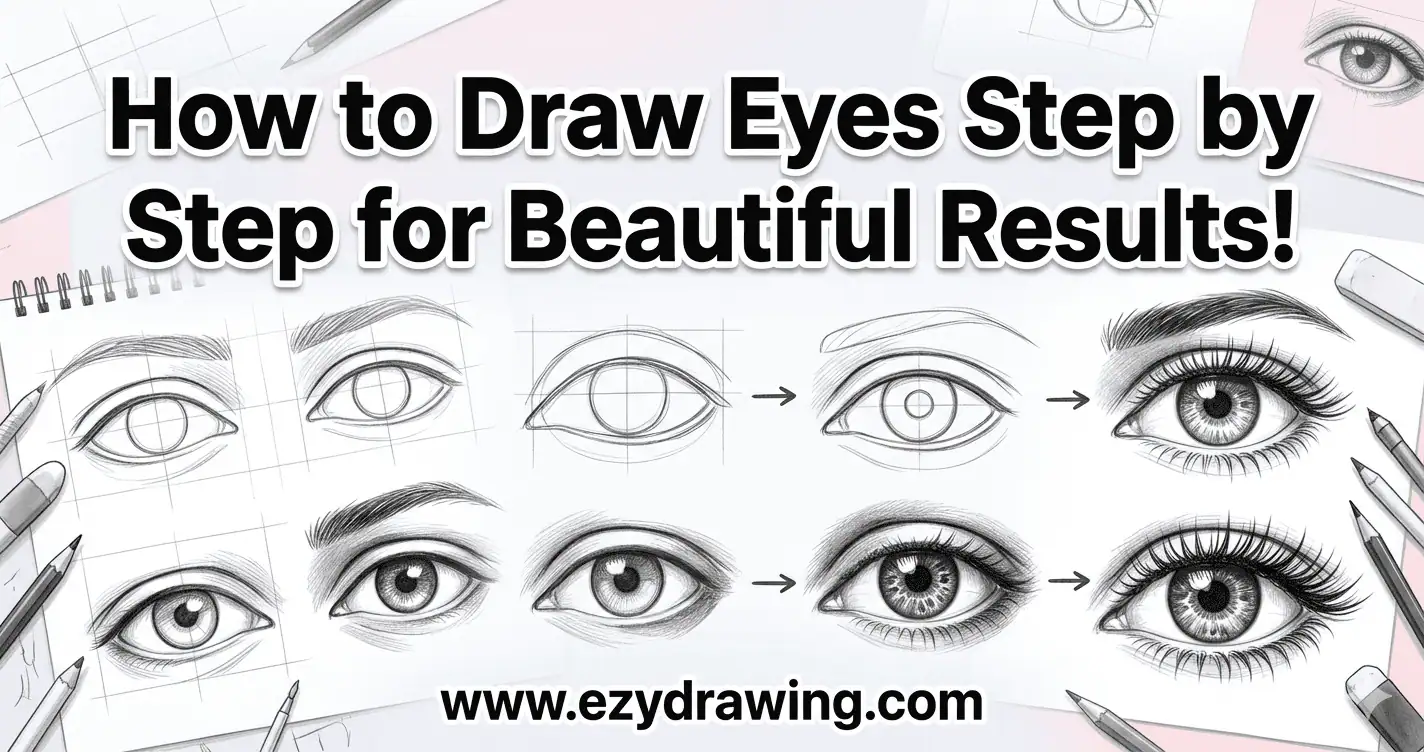
How to Draw Eyes Step by Step for Beautiful Results
Welcome to this tutorial! Drawing realistic eyes is often considered one of the most challenging (and rewarding) skills in portraiture, especially when learning how to draw eyes.
The secret isn’t a complex, magical technique; it is a simple, structured process of building form through layers of light and shadow
In this guide, we will break down the construction of a human eye into six clear, manageable steps. We will start with fundamental geometry and gradually refine the structure, add anatomical details, and finally, apply shading to create depth.
By strictly adhering to these foundational stages, you will create a convincing, dimensional drawing while improving your how to draw skills. Let’s begin.
Simple Eye Drawing Tips for New Artists
How to Draw Eyes for Beginners with Easy Sketch Tips is a simple and helpful guide for anyone who wants to learn eye drawing without feeling confused. In this tutorial, you will start with basic shapes, build the eyelids and iris, add soft pencil shading, and finish with eyelashes and small details.
Each step is beginner friendly, making it easier to understand how an eye is formed and how light and shadow make it look realistic.
Step 1: Laying the Foundation (The Basic Sphere)
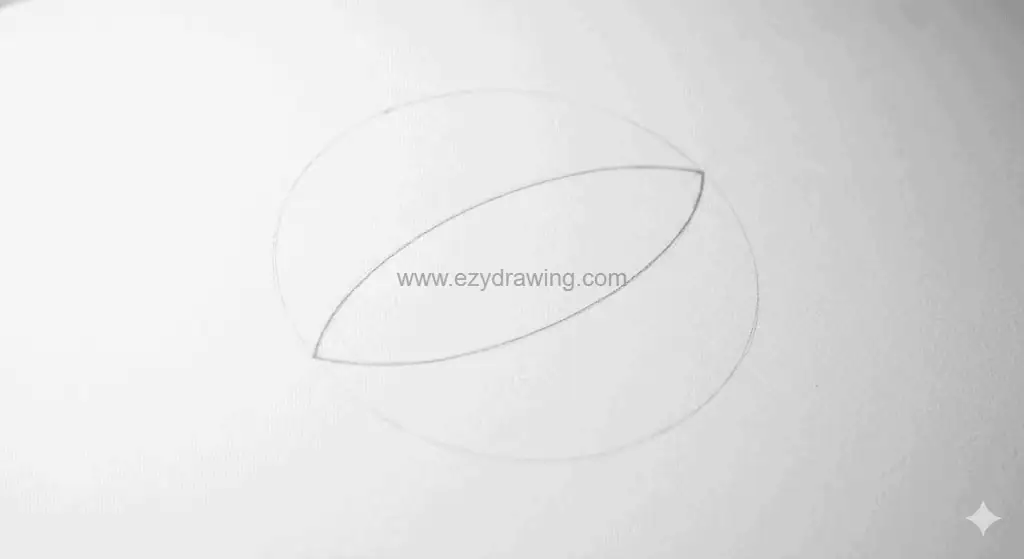
The single most common mistake beginners make is drawing the eye as a flat shape directly on the paper. To achieve realism, we must first recognize its underlying structure: the eyeball is a sphere. Before we define eyelids or lashes, we must establish this geometry.
Added naturally:Start with a clean sheet of paper and a light pencil (an H or HB is perfect). Draw a gentle, precise circle. This defines the overall volume. Next, lightly sketch a simplified almond shape (an asymmetric ellipse) intersecting the sphere.
This almond represents the opening formed by the eyelids. At this stage, your lines must be faint and purely structural; do not draw details yet. This circle establishes the volumetric form that will later guide all our shading as you practice how to draw eyes.
Step 2: Defining the Key Features (Iris and Pupil)
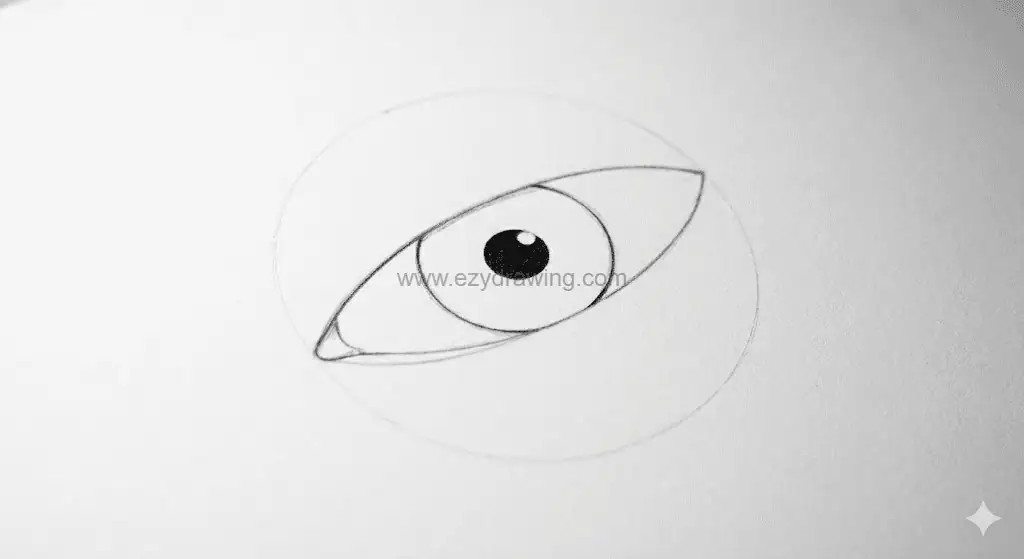
With the foundational structure (Image 0) established, we can now define the features inside that opening.
Added naturally
Looking closely at your structure, locate the center of the sphere. Draw a smaller, perfect circle here. This will be the iris. Crucially, in a relaxed, front-facing view, the upper portion of the iris is always slightly covered by the upper eyelid.
The circle should not float in the center of the opening; it must hang from the top edge. Inside the iris, add a smaller, concentric circle: the pupil. Finally, define the visible caruncle (the tear duct) as a small, rounded triangular shape in the inner corner (near the nose) while practicing how to draw eyes.
The image provided (Image 1) shows how these key shapes interact with the geometry established in Step 1. The lines remain light, but the anatomy is now clearly defined.
Step 3: Establishing the Folds (Lids and Plane Changes)
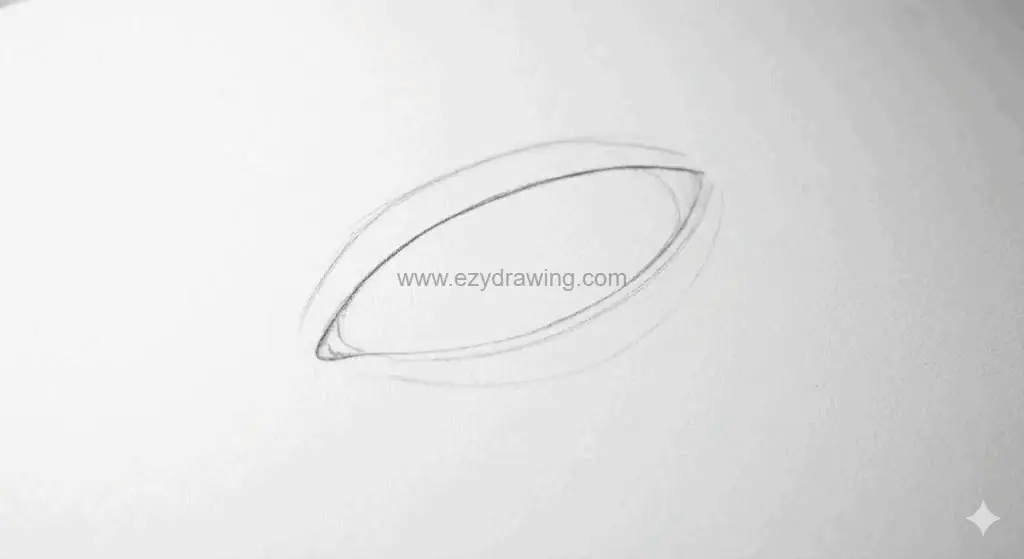
The structural framework (Images 0 and 1) is now in place. We must transition from 2D linear shapes to 3D planes. We do this by defining the surrounding volume.
Added naturally
Observe the image: We start by defining the thickness of the eyelids. These are not paper-thin lines; they have volume. Add a soft, parallel line just above the upper eyelid (defining the upper lid crease) and a subtle, softer fold line below the lower lid. Now, erase or soften your original construction sphere.
We use the original circle as a guide to place these planes of flesh: the upper socket and the soft tissue below. The eye opening is now nestled within a defined socket. This image shows the anatomy clearly, ready for shading, much like careful line control used in how to draw hair tutorials.
Step 4: Introducing Shading and Depth
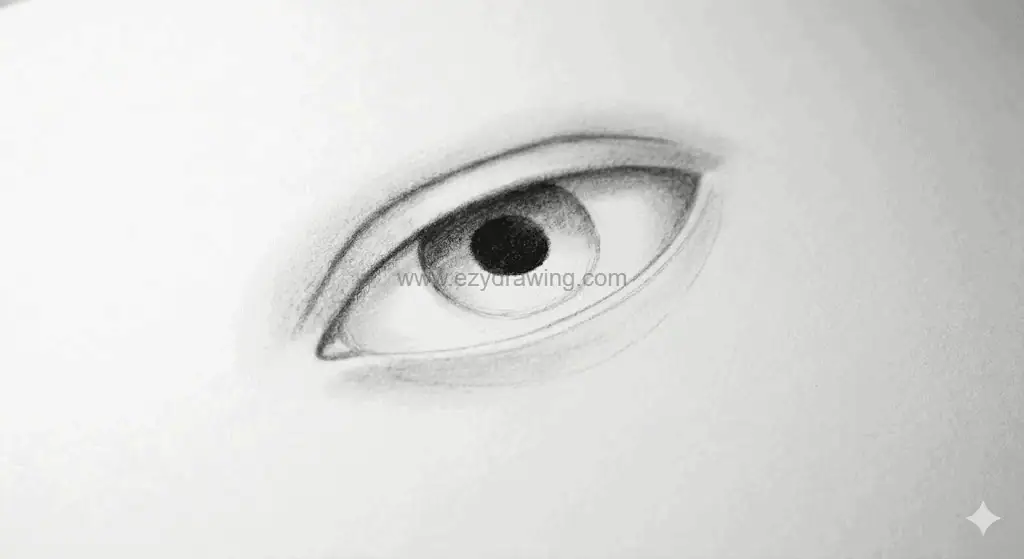
Until now, we have worked only with lines. Step 4 is the transition from line to value. We are going to apply shadow to make the eye look three-dimensional.
Refer back to our original structure (Image 0). The entire eyeball is a sphere. Even though the eyelids cover most of it, the white of the eye (the sclera) must still be shaded as a rounded surface.
We now darken the pupil. Then, lightly shade the top third of the iris. This is crucial: the upper eyelid casts a significant shadow, creating depth. Use soft graphite blending (perhaps a 2B pencil) to smooth the tone.
Add soft shading into the upper eyelid crease (defined in Image 2) and in the inner corner near the tear duct. Note that this step shows form but not details like individual lashes or complex iris patterns. The image provided illustrates the eye beginning to ‘recede’ into the socket.
Step 5: Adding Texture and the Eyelashes
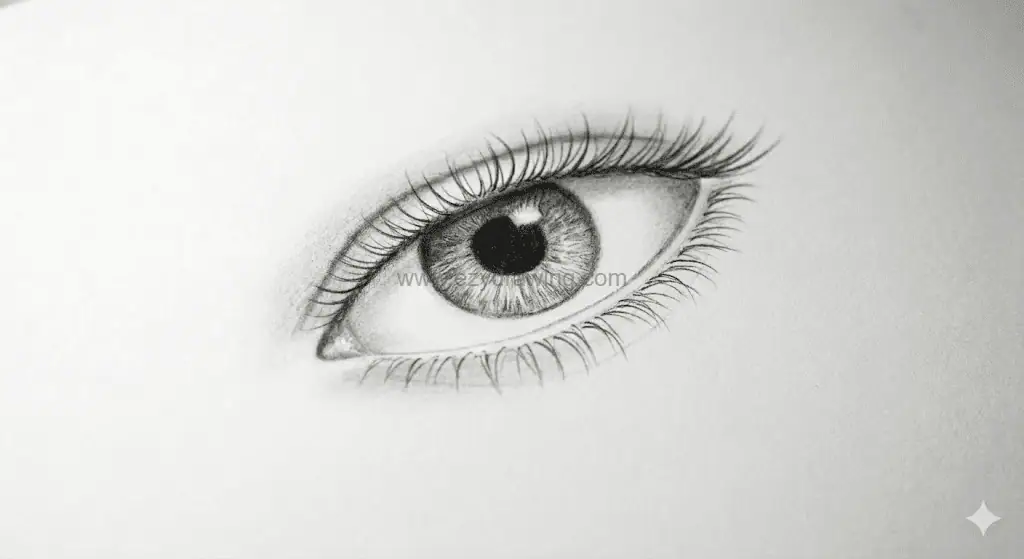
The structure is sound, and the form has depth (Image 3). Now we can apply the surface details that beginners often start with too early. Step 5 is about texture and decoration.
Start with the lashes. Eyelashes are not straight lines. They are tapered hairs that curve from the outer edge of the eyelid margin (the thickness we defined in Image 2). They should be rendered with quick, curved, flicking motions. Group them slightly and vary their length; lashes near the caruncle are tiny, while those at the outer corner are long and sweep outward.
Next, add texture to the iris. It is not a flat gray; it is composed of radiating fibrous structures. Draw subtle, irregular lines radiating from the pupil toward the outer edge of the iris. Look closely at the image: the upper lashes are dense and dark, while the lower lashes are sparse, fine, and subtle.
Step 6: Finalizing the Contrast (Refinement)
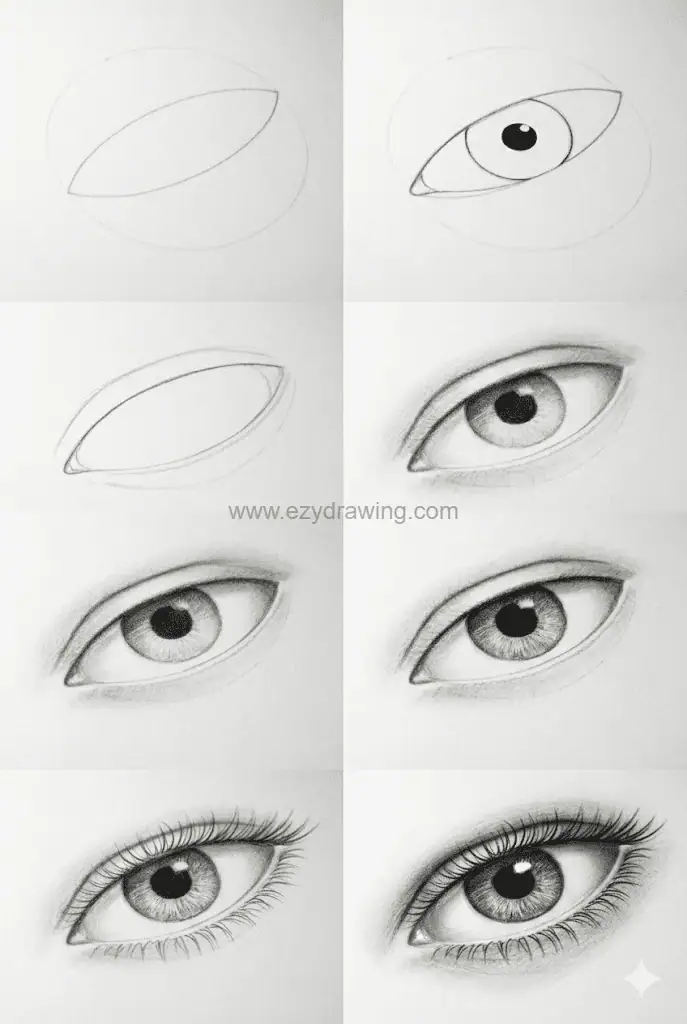
The drawing now has all its components (Image 4). The final step is to unify the piece and maximize the realism by pushing the tonal range—making the darks darker and the lights brighter.
Get your darkest pencil (a 4B or 6B) and deepen the pupil to maximum black. Re-state the shadow cast by the upper eyelid onto the iris and the sclera; this shadow must be deep and soft. Use an eraser (a kneaded eraser works best) to clean and sharpen the main catchlight (the bright highlight) on the wet surface of the eye. This highlight must be pure white and sharp.
Finally, gently shade the lowest part of the iris to create a reflection of light (refraction) opposite the main light source. Add very soft skin shading around the socket to finish the portrait. This image represents the complete, dimensional drawing.
Conclusion
Added naturally
By following this structural approach—moving strictly from geometry (sphere/almond) to anatomy (iris/lids), then to volume (shading), and finally to detail (lashes/texture)—you can draw a realistic eye while learning how to draw eyes. The final composite image (Image 5) provides a complete overview of this 6-step journey.
Remember that the realism doesn’t come from the eyelashes; it comes from the fundamental shadows established in Steps 3 and 4 that define the underlying sphere. If your underlying structure is weak, no amount of detailed texture will make the eye look real. Master the basic volumes first. Keep practicing this sequence, and you will see consistent improvement.