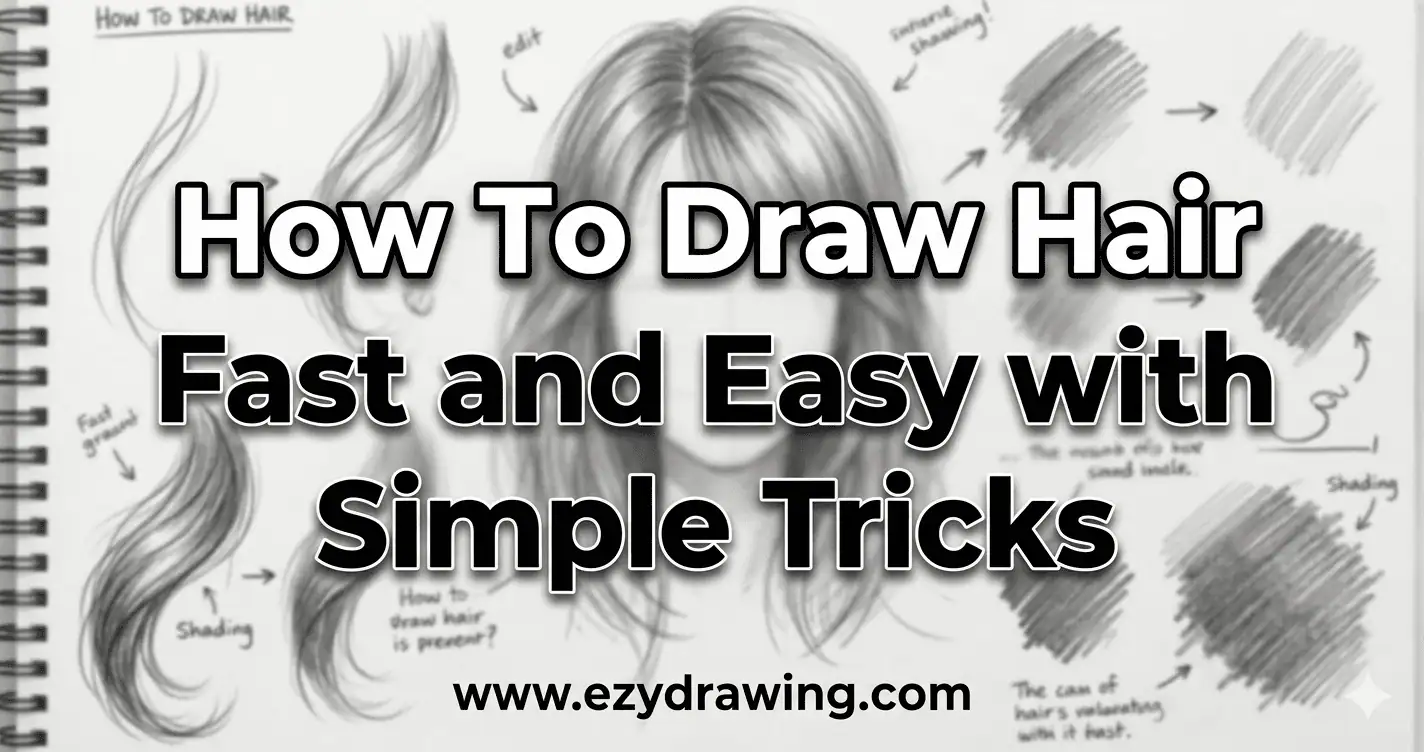
How To Draw Hair Fast and Easy with Simple Tricks
Hair often seems intimidating because of its sheer complexity and thousands of individual strands. However, the secret to drawing convincing hair isn’t drawing every strand; it’s understanding the structure first. If you can define the volume and the major planes, adding texture becomes easy when learning how to draw hair.
Simple Hair Drawing Tricks for New Artists
How To Draw Hair Easily for Beginners is all about learning the basic shape, volume, and flow before adding tiny strands.
Instead of drawing every hair one by one, beginners should first sketch the head shape, mark the hairline, divide the hair into simple sections, and then add soft pencil lines for texture when learning how to draw hair.
This makes the whole process easier, cleaner, and more realistic for anyone practicing hair drawing step by step.
This tutorial breaks down the process of drawing hair into six logical, manageable steps.
Step 1: The Foundation – Drawing the Sphere
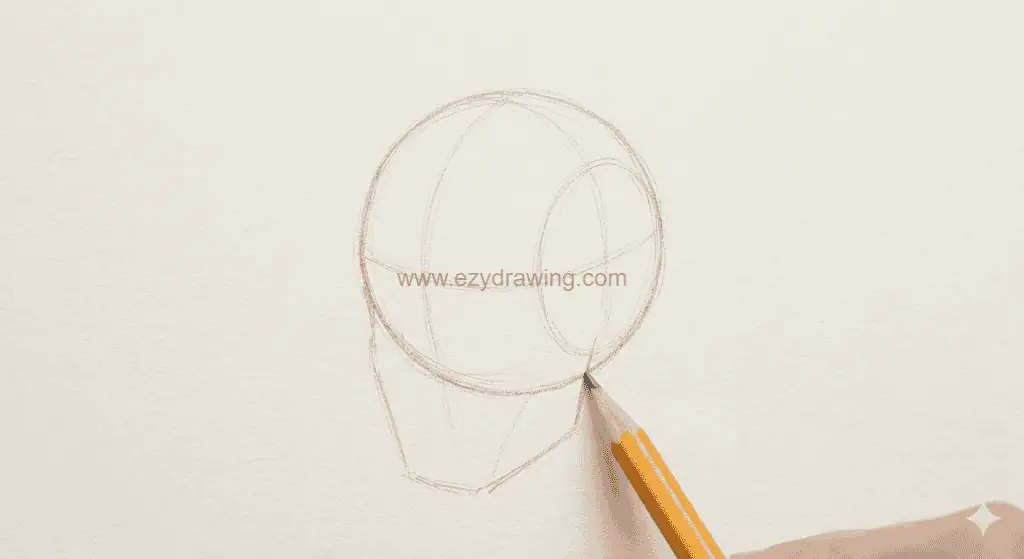
Before we can add hair, we need to establish the form it rests upon. Do not start a drawing by sketching lines on a blank space.
The head is, fundamentally, a sphere (representing the cranium) with a jaw attached. When you begin drawing hair, visualize it as a cap or volume that fits over this sphere. It must follow the underlying curvature.
Start by lightly sketching a simple circle. Use a soft pencil, like an H or HB. Avoid any facial details for now; the focus is purely on establishing the geometry that defines the hair’s volume when learning how to draw hair.
Figure 1: The structural base. Just a clean sphere sketched lightly with an HB pencil.
Step 2: Defining the Volume and Hairline
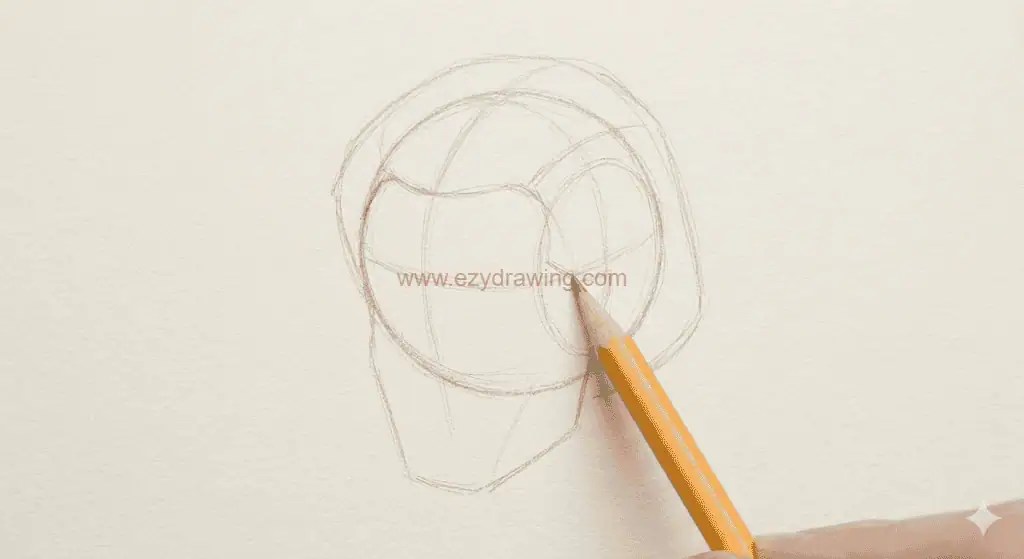
The most common mistake when drawing hair step by step is starting directly on the cranial circle. If you do this, the character will look like they have flat, spray-on hair.
Instead, define the volume of the hair. Hair is light and thick; it has loft. Draw a second, larger perimeter line outside your foundation sphere. This new boundary establishes how much space the hair occupies. Notice the gap between the sphere and the new line in Figure 2. This distance represents the mass of the hair.
Also, lightly mark the hairline. This is the boundary where the hair meets the forehead. Getting this placement right is critical for a natural look when learning how to draw hair.
Figure 2: Building mass. A volume line defines how far the hair sits off the head (the sphere).
Step 3: Mapping the Structure (Blocking)
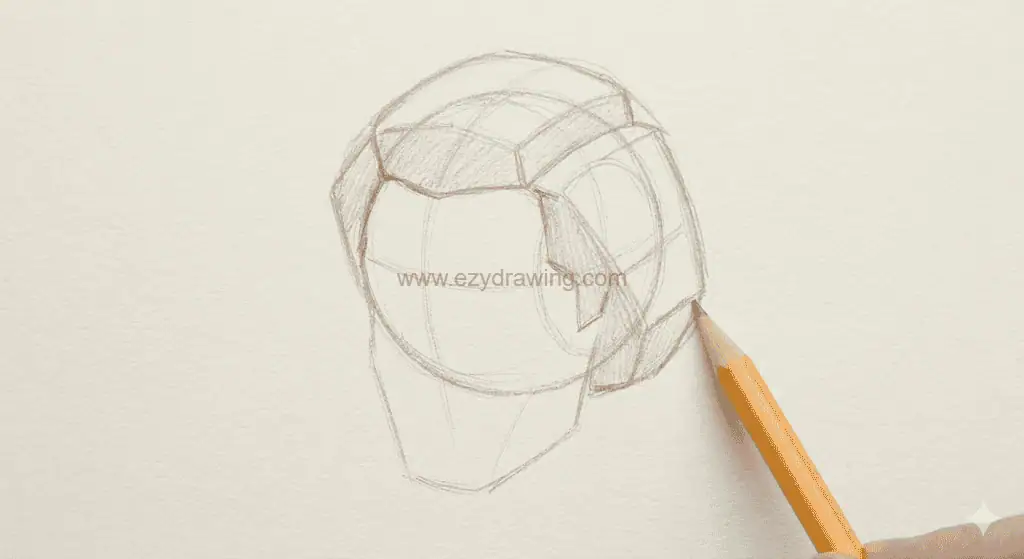
With the total volume established (the “helmet”), we now break that mass into manageable sections or planes. This is the most critical step for structure.
Don’t draw strands! Instead, draw large, ribbon-like shapes that curve around the sphere. Observe the light and shadow planes.
Think about how you might approach how to draw anime hair: you group large sections of hair together into cohesive, sharp shapes. In this step, we are doing the same structural work, but keeping it soft while learning how to draw hair. In Figure 3, the hair is segmented into three or four large, curved sections, establishing the flow from the crown. We are blocking out where the major “clumps” will go.
Figure 3: Structure and Flow. The volume from Step 2 is sectioned into ribbon-like planes that establish the major flow.
Step 4: Introducing Directional Flow and Core Shadows
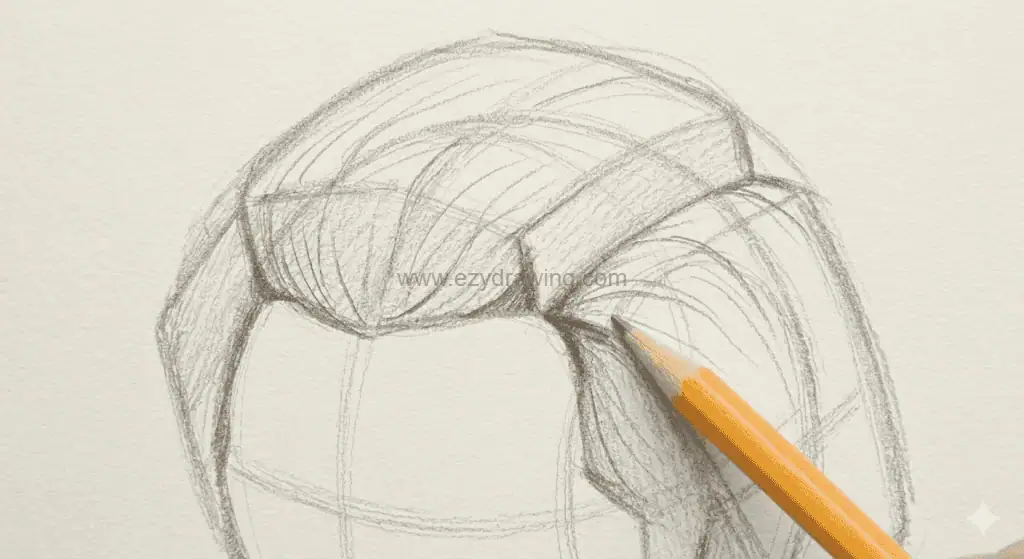
We are now ready to move from simple geometric blocks to flowing hair. This is the transition point where structure begins to look like texture.
Using the major planes from Step 3 as your guide, begin drawing curved lines that flow within those sections. These lines don’t represent individual hairs yet; they are directional markers. They tell the viewer which way the hair is moving.
Crucially, define the core shadows (the darkest areas) where the large planes of hair overlap or recede from the light. This is visualized in Figure 4, where the pencil begins defining the dark recess between the top volume and the side section. If you are learning how to draw hair male, this is where you define the short, tight transitions often found in masculine styles.
Figure 4: Direction and Depth. Lines are drawn within the established planes (from Step 3) to guide the flow, and shadows are darkened where masses overlap.
Step 5: Defining Texture and Value (Rendering)
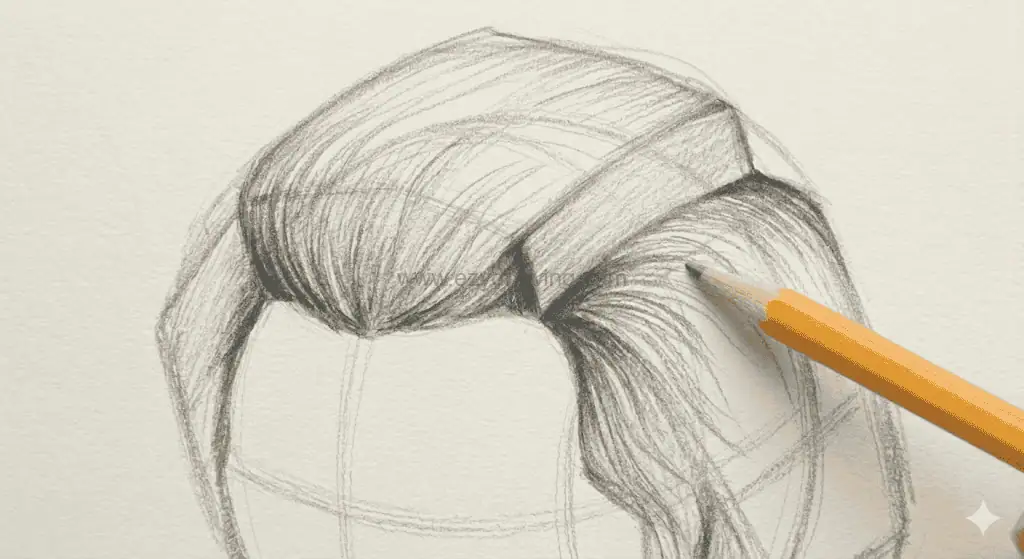
The final step is adding the specific texture. Now you can finally use rapid, directional strokes, but remember: you must follow the guide paths you established in Steps 3 and 4.
If you are learning how to draw curly hair, this is where your strokes become S-curves or small, looping groups, always adhering to the blocked volume. The underlying structure (the “helmet”) still dictates the overall shape; the curls just provide the surface texture.
For the drawing in Figure 5, use a darker pencil (like a 4B or 6B) to deepen the shadows and define the fine edges of the hair clumps. Blend the strokes slightly to create soft gradients, leaving areas of bright white paper to serve as highlights. The result is a mix of soft volume and defined texture while practicing how to draw hair
Figure 5: Rendering texture. Darker graphite (4B) is used to define fine strands and create deep shadows, transitioning the structure into believable texture.
Step 6: Step-by-Step Drawing Guide (Summary)
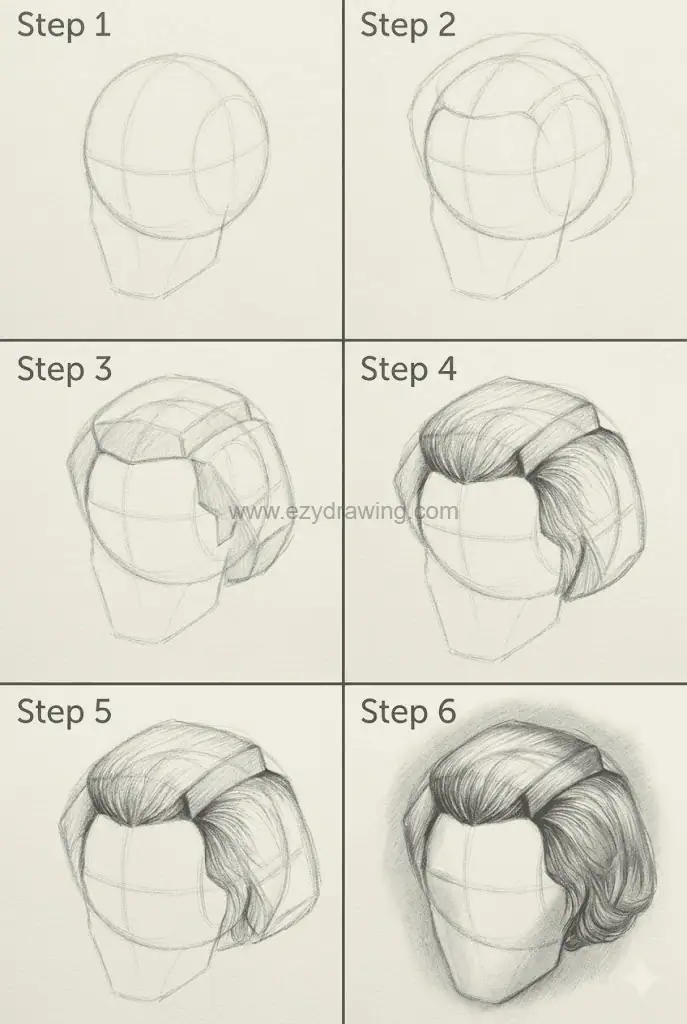
The entire process of learning how to draw hair step by step is a logical progression from simple geometry to complex texture. Each stage must be successful before moving to the next.
Figure 6 summarizes this journey. By following this structured workflow, you ensure your drawings always have depth, volume, and correct anatomy.
Summary Checklist:
- Foundation: Sketch the cranial sphere.
- Volume: Define the total mass/loft of the hair above the sphere.
- Blocking: Section the mass into large, simple structural planes.
- Direction: Use inner lines to establish the flow of clumps. Define core shadows.
- Rendering: Apply texture (straight, wavy, curly), layering dark graphite and preserving highlights.
- Review: Ensure the rendered texture perfectly adheres to the blocked structure.
Figure 6: The complete six-step workflow, summarized in a 2:3 tutorial matrix.