How To Draw hands Simple Step By Step Sketches
Drawing hands is often considered one of the most challenging aspects of figure drawing. Many artists struggle with the complex anatomy, foreshortening, and the sheer number of moving parts. However, by breaking the process down into manageable steps and understanding the underlying geometry, you can master how to draw hands.
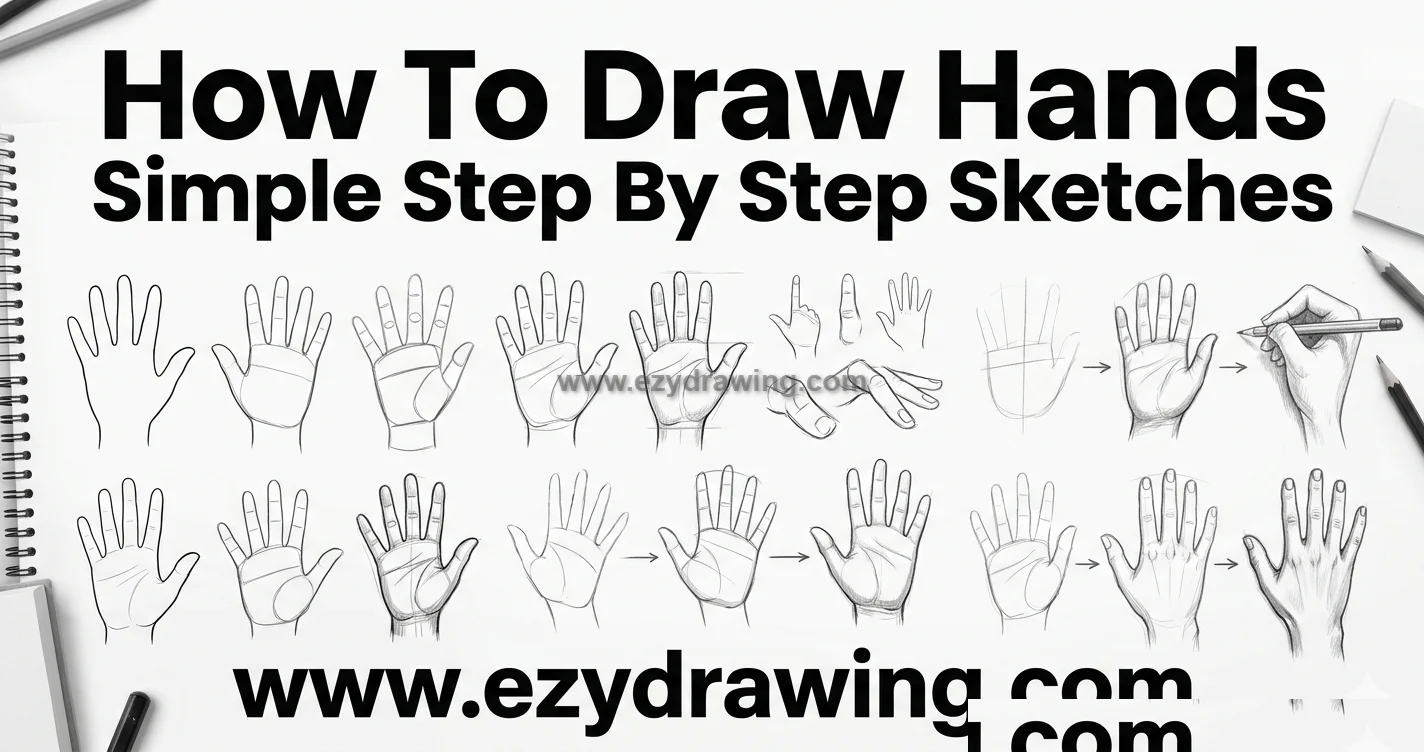
This tutorial will guide you through six essential steps, making it easier to understand how to draw with confidence, moving from basic structure to refined detail. The final image will provide a comprehensive summary, displaying all six stages in a compact 2:3 ratio chart.
Easy Hand Drawing Instructions for Beginners
How To Draw hands Easy Creative Pencil Art is a fun and beginner-friendly way to practice one of the most expressive parts of the body. Start with simple shapes, light pencil lines, and basic finger placement before adding details like knuckles, nails, and soft shading, making drawing hands feel less difficult for beginners. With each step, your hand sketch will look more natural, creative, and easy to improve.
Step 1: Establishing the Core Structure
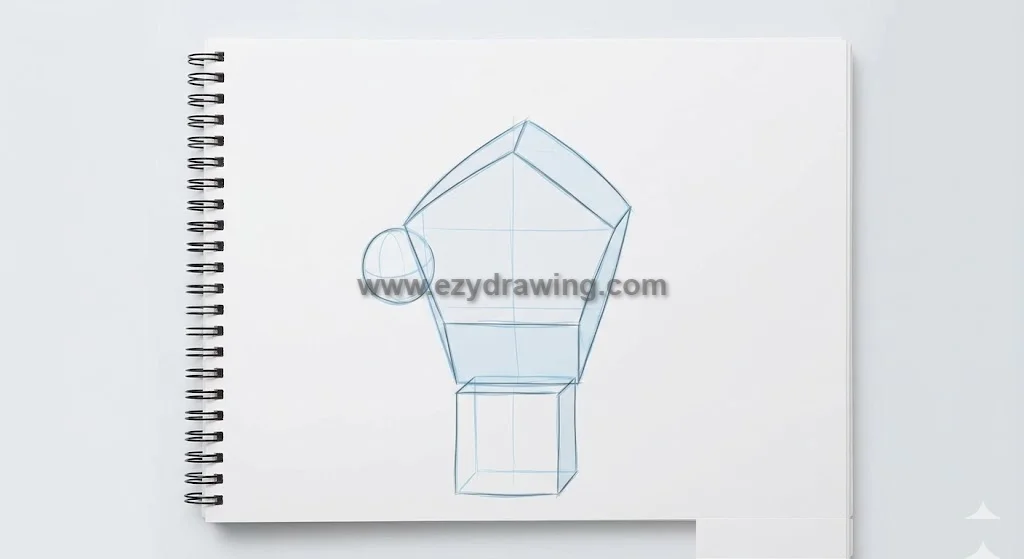
The first critical step in understanding how to draw hands is to visualize the primary masses. We begin not with lines, but with simple, solid geometry. The wrist is established as a sturdy block, and the main body of the hand (the palm and back) is defined by a slightly curved, pentagonal form.
This shape accounts for the bulk of the metacarpals. It’s essential to keep this structure simple and solid; it dictates the orientation and volume of the entire hand. We place the first joint of the thumb as a small sphere attached to the side, defining its insertion point.
Image 1: Initial Structure. The hand begins as a solid wrist block and a pentagonal main form.
Step 2: Mapping Fingers and Joints
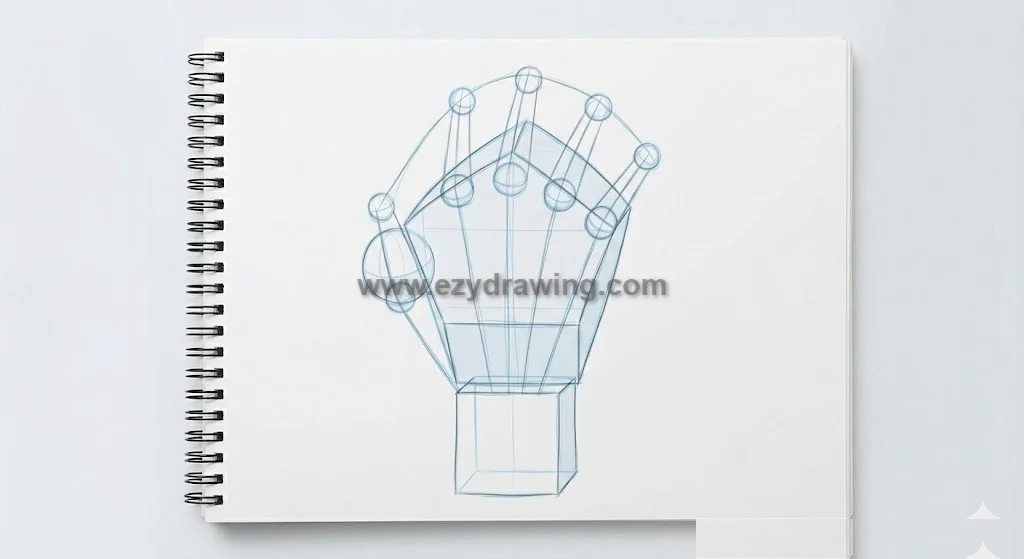
Once the main structure (Image 1) is secure, we define the skeletal framework for the fingers. We extend simple, lightweight wireframe lines from the main knuckles (the edge of the pentagon) to establish the correct length and direction for each finger.
Small spheres are placed precisely on these wires to mark the location of the proximal and distal joints (the knuckles). Note that the knuckles of the index, middle, and ring fingers form a gentle arc.
These simple wires and spheres (which now overlap the original structure from Image 1) act as the definitive map for the complexity to come.
Image 2: Mapping Joints. Wireframes define length, and spheres mark the exact location of the joints.
Step 3: Fleshing out the Volumes (3D Form)
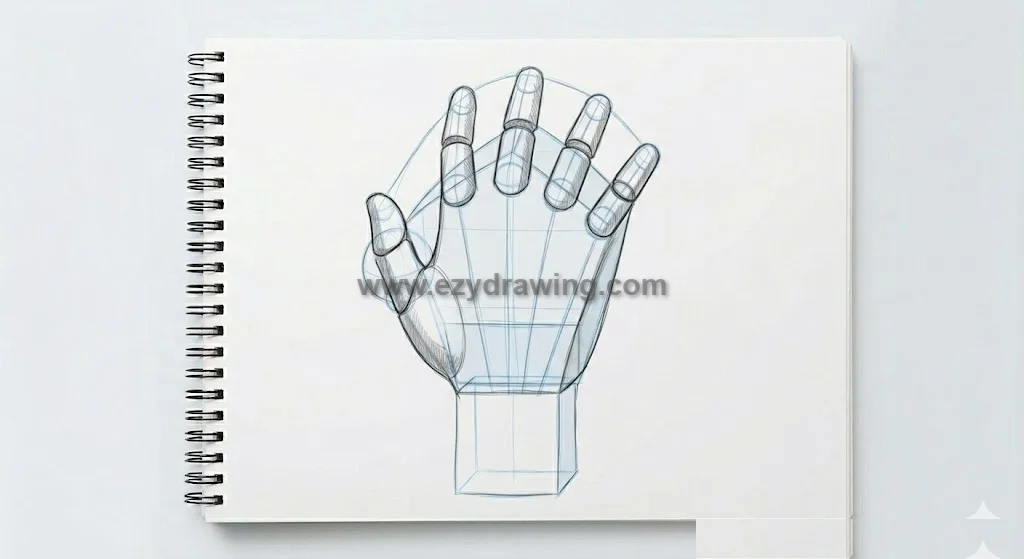
This step transforms the 2D map into 3D form. We transition from simple lines and spheres (Image 2) to three-dimensional volumes. Every segment of the finger (proximal, middle, and distal phalanges) is drawn as a distinct 3D capsule or cylinder. These shapes connect the joints, following the established wireframe paths.
Notice how the muscles and flesh define these forms; the segments are thicker near the joints and taper slightly. A substantial, complex 3D volume is created for the base of the thumb (the thenar eminence) using a combined sphere and elongated block. The structure from Image 1 is now entirely enclosed within these new volumes.
Image 3: Fleshing out the Volumes. The skeletal map is covered by distinct 3D capsules for each finger segment.
Step 4: Defining Contour and Skin Segments
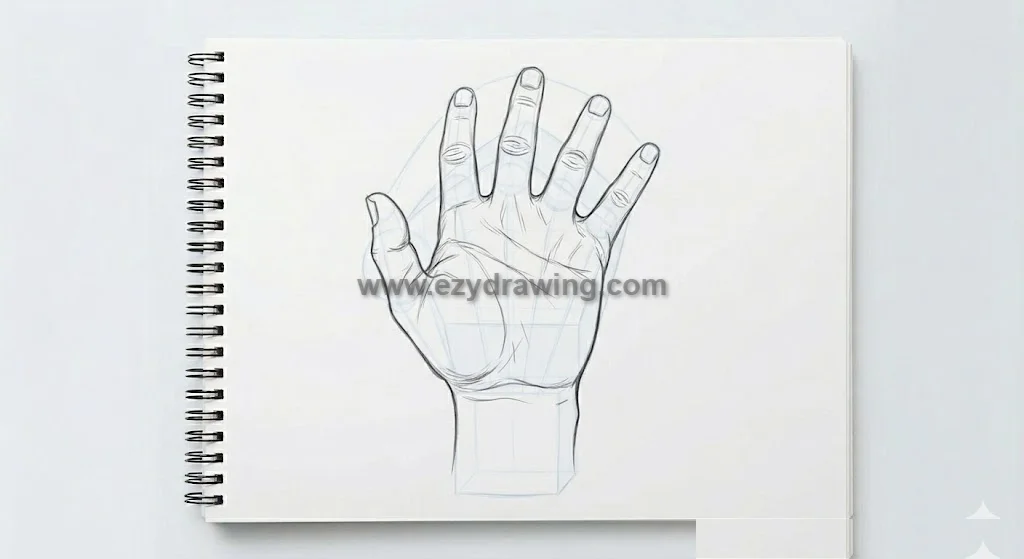
We now move from drawing structure to defining anatomy. The underlying 3D forms (from Image 3) are merged using smooth, organic contours. We draw the continuous silhouette of the hand, defining how the skin flows over the knuckles and pads.
It is critical to draw the specific creases and skin folds: the major palm lines (lifeline, head line), the small folds where the fingers bend (Image 2 joints), and the webbing between the fingers. This stage defines the character of the hand, showing where the skin is tight or loose. The sketch lines become confident and descriptive.
Image 4: Organic Contours. Smooth graphite lines define the outer silhouette and the specific creases of the skin.
Step 5: Introducing Depth with Light and Shadow
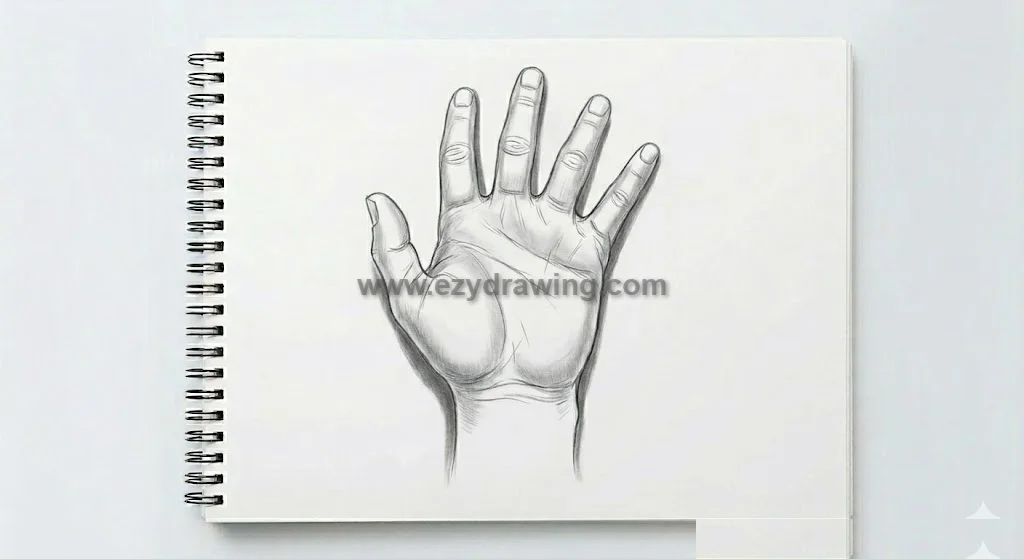
The drawing has a definitive shape (Image 4), and now we use rendering to ground it in space. We establish a clear light source (in this case, from the upper left). Subtle, soft graphite shading is applied to the planes of the hand that turn away from the light.
This means darkening the sides of the 3D fingers (the capsules from Image 3) and the receding areas of the palm structure (from Image 1).
We add soft cast shadows: the fingers cast faint, defined shadows upon the palm, and the base of the thumb casts a shadow. This shading is not arbitrary; it adheres strictly to the underlying volumetric forms established early on.
Image 5: Shading for Depth. Soft graphite defines the volumetric forms of the pads and fingers, referencing the original geometry.
Step 6: Final Details and Refinement
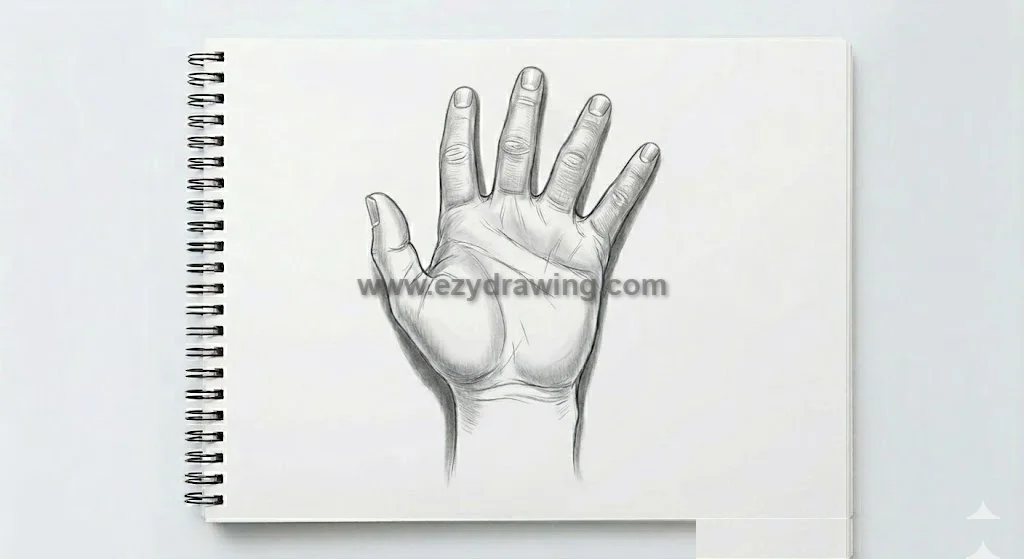
The final step is to refine and polish the image, elevating the drawing (Image 5) to a completed state. We introduce specific, fine details: the fingernails (which define the tip orientation), subtle wrinkles around the joints, and texture in the skin of the palm.
The overall lighting is integrated, and contrasts are subtly increased to make the forms pop. Crucially, the light blue construction lines that initiated the process (seen first in Image 1 and faintly in later steps) are lightened or completely erased, leaving only the clean, volumetric graphite drawing on the page.
Image 6: Final Polish. The finished graphite drawing, detailed with fingernails and skin texture, with initial construction lines removed.
Step 7: Summary: All Six Steps
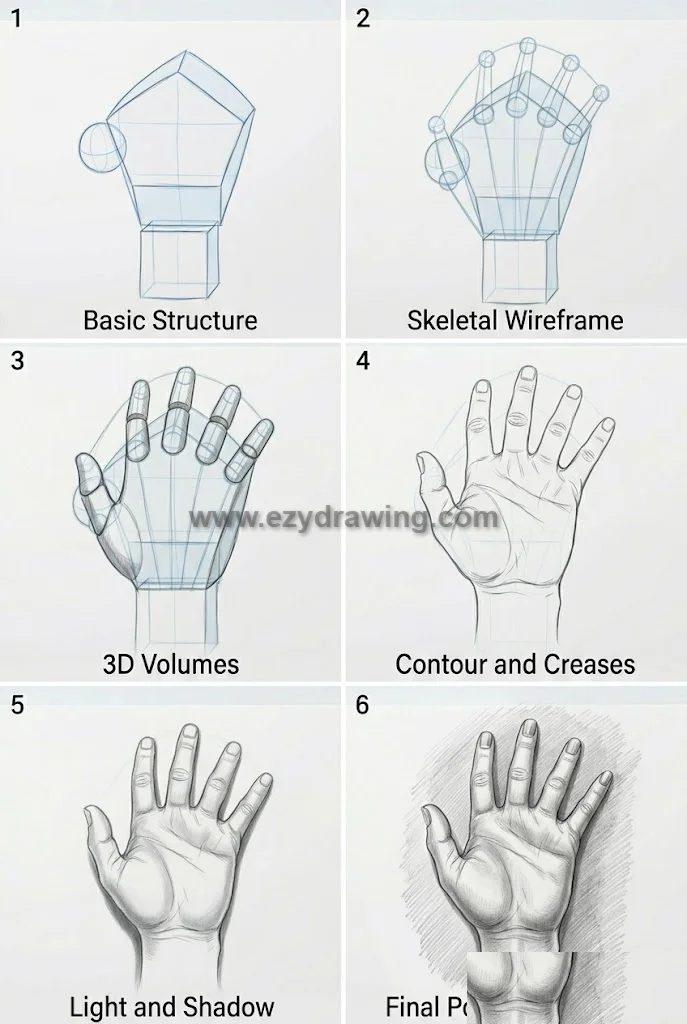
The final image below provides a comprehensive overview, presenting all six steps of this tutorial in a single, sequential chart. It illustrates the journey from basic structure (Step 1) to final polish (Step 6), allowing you to review how how to draw hands involves building dimensional forms upon a solid geometric foundation.
Image 7: Summary Chart. A 2:3 overview showing the 6 steps: 1. Structure, 2. Wireframe, 3. 3D Volumes, 4. Contours/Creases, 5. Shading, 6. Final Polish.
Conclusion
Mastering how to draw hands is achievable when you approach it methodically. By progressing from primary structures (like the wrist block and palm pentagon) to defining joint locations, fleshing out 3D volumes, and finally refining contours and shadows, you gain control over this complex subject.
Remember that the final polish (Step 6) always relies heavily on the foundational structures established in the very first steps. Consistent practice using this structured method is the key to successfully understanding and executing how to draw hands in any pose or perspective.